Tuesday, February 6, 2018

Valentines Regatta Debrief & Recap


Laura "Lulu" Hamilton won the 2018 Valentines Regatta without having to sail the last race as LYC sailors excelled in St. Petersburg this past weekend. Sailing 6 races in varied conditions against 150 boats, this was a challenging regatta for the 15 sailors that raced with our team, so the sailors that did well really earned it! Here's the top of the leaderboard:

It was even better by Fleet. LYC in Red: 1, 4,5    Blue 1,7,8      White: 1st James Asturias, 5th Drew Lamm and 7th Skye Johnson. 

The regatta was the first big fleet race of the '18 Spring Season, and as a USODA sanctioned event, a qualifier for Team Trials. The US Opti Team Trials will be this April 26-29th at Key Biscayne Yacht Club where the ~250 best Opti sailors in the country will race to qualify for the National team, and invitation to international regattas. At Valentines and other USODA events, finishing in the top 25% of all registered boats (green and champ) gets you an invite to Team Trials. 

With many good sailors (including Stephan Baker) in Mar De Plata, Argentina, Valentines is considered a good opportunity for sailors who have been improving throughout the year to qualify. Confirmation pending, we think  4 new LYC sailors made this goal with Ty Lamm, James Asturias, Drew Lamm and Skye Johnson in the top 50 overall  (over 200 entries) to qualify for the first time! 


We arrived in St Petersburg late Friday morning and prepared for a practice. A number of Northern Teams were already rigging up - CERT from NJ, LIMA (Long Island Mid Atlantic), Buddy Melges of Wisconsin, Annapolis YC and others. But there was no wind and we were the first Florida team there! When we got on the water at 2:00pm there were remnants of a light, light easterly that had wafted for a couple hours. There was also a sailboat to the north heeling over in a stout Northerly! Bam, the wind shut off and we had the kids rock to a dark band of breeze that was sliding down the bay from the north. We sailed a long upwind, testing speed and practicing technique, and then 2 practice races in a 8-13kt Northwest Wind.  It was good for Robby Brown who was coaching with us to get to know each sailor, and I made some suggestions with where some sailors should sit upwind and downwind. Its important to balance the boat completely flat and be connected to the boat. 

Upwind in the Opti in Chop: 
 - Sit 4-6 Inches Behind/Aft of the Bulkhead. 
 -Knees and feet together and pointed to leeward. 
 -Front foot connected to hiking strap. Even if you are not hiking kick your foot under the strap and ankle into it! 

*Hydrodynamic explanation: the Opti Bow crates a lot of drag when it gets hit by waves. Try to keep the bow transom just above the waves, and keep the boat connected to the waves so there is minimal "pounding". 

Downwind in Light/Medium:
  -Point knees forward and slide forward until your shins hit the bulkhead. This hurts a little bit but keeps you connected to the boat, and sitting in the widest part (helps you heel it over to windward more). 
 - Dont worry about bow plowing! The bow dips low on a wave, you go back with your shoulders, pump the sail, and get surfing! 

*Hydrodynamic explanations: 
 - The stern is wider than the bow so when you heel (kite) to windward, the stern digs in more. So for equal dig, you need to move forwards vs upwind when you sail flat. 
 - The waves are coming from behind you now so the bow drag is not an issue. 

Ryan Kronrad showing good medium air technique at an LYC practice. 

While you can't learn technique overnight in the heat of a regatta, I think our sailors worked really hard to sail with good technique throughout and improved a lot. Kevin Gosselin had been working hard in the weeks of practice prior to clean up his technique, to work the waves in a sharper, but smoother and more precise fashion, and to limit rudder movement (causes drag!). He had a breakthrough regatta with only one race deeper than 10! Deana and Avery were two girls joining us form the Chicago Yacht Club who were sailing for the first time this year. Deana quickly regained her technique and had top 10 speed for most of the regatta, while Avery improved a lot in this area as well. Each sailor went into the regatta knowing something they had to be better about with technique - sail trim for Skye, Holding the end of the tiller extension when he hikes for Drew, consistent top speed and fast transitions for the top sailors like Jack, Lulu and Peter. 

In the practice races there was a bit of current and some general recalls, and some Black flag disqualification in the practice races - I was the race committee as we scrimmaged with Annapolis, KBYC and friends around a trapezoid course. Lulu won at least one of the practice races and we knew we had a good team. 13 of the 15 sailors that sailed with LYC made it out to practice on Friday! 

At the evening debrief there were 2 messages, Keep it Simple, and watch the current! We noted to the kids that we had just practiced close to shore - out 2-3 miles in Tampa Bay they should expect a lot more current. We went over the tide change predicted times and talked about how you can see current on anything that is anchored. Keeping it simple means focus on getting good starts, clear air and boatspeed through technique. Don't tack more than you need to and be patient with the side of the course you choose in the relatively stable breeze we were expecting. 


Saturday we sailed the first race in over 12 Kts of Breeze from the North and it was basically a speed test. Out in the bay it was pretty consistent, with the tide running downwind and about to change, and the breeze lessening throughout the race. Connor won the first race of the regatta with Peter right behind him in 2nd. In the 2nd Start Lulu won with Jack 2nd narrowly beating CRYC's Freddie Parkin in 3rd. Around Mark 2 I witnessed this exchange between Lulu and Jack:
   Jack: "Hey Lulu, I don't see the Gate, where is the next mark?"
   Lulu: "Here Jack!" [Lulu Points here whole arm to the Gate to show Jack the way to go].

It was pretty hilarious to see this from the Coachboat and Lulu learned an important lesson about racecourse friendship when Jack covered her air later on the run, and pushed hard for inside overlap -passing her and slowing them both down! This put Freddie Parkin back in the race as all 3 sailors rounded the Mark just boatlengths apart, and then shuffled positions multiple times as each sailor ran forward to tighten their sprits! 
    I think we can get faster at this maneuver and you should wait to tighten your sprit if it means immediately giving up a place! You can go alright for 20 boat lengths with a sprit that is too loose, then tighten when you have a bigger lead because the boat behind you sat in your dirty air. In addition, taller sailors should pull on the sprit on the downwind 5-10 boat lengths before the leeward mark when it costs nothing! 
    Lulu battled back passing Jack on the top left of the course and Drew, Graceanna and Kevin had solid first races. Deana had a top 10 but was Black Flagged! 


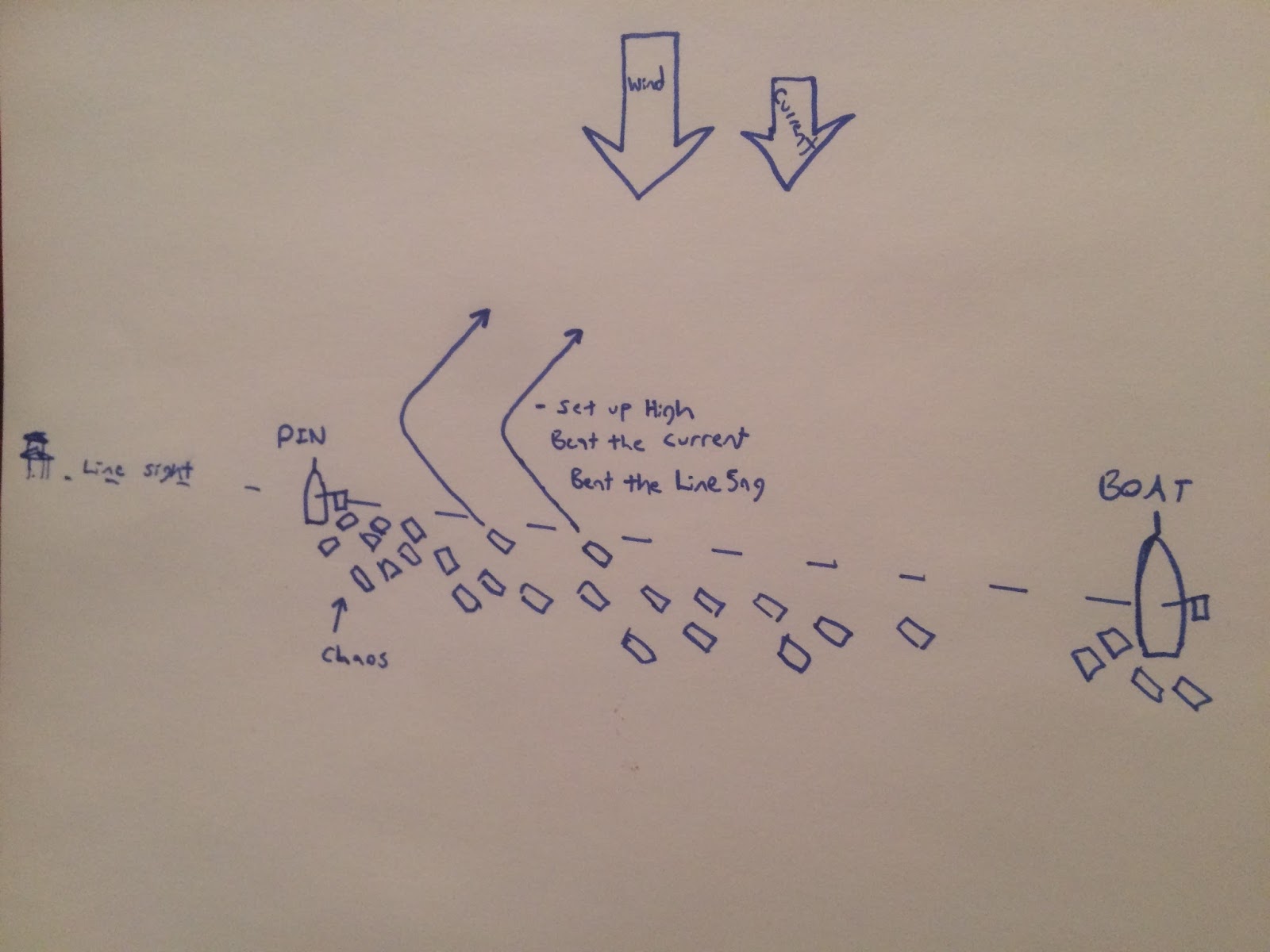
The next race was the most sketchy of the regatta. We had passed low tide, and the current was starting to Flood back into the Bay from the South. The Northerly wind was lightening. So the current was pushing hard over the line - Classic Valentines Regatta conditions! Really! Here is a picture I drew about the 2016 Valentines Regatta that approximates the situation:


As the pin was Favored (further upwind than the Committee Boat end of the line), I recommended to my sailors the Port-Tack Approach. I think it is ideal for Plus current and pin favored Starts, I do it a lot in my own racing, and it was a favorite strategy of Ian Barrows when he placed 2nd at Opti Worlds. 


If you look at how the fleet stacks up at ~1 Minute and understand well how much current there is, you can see if it is going to be a genereal recall. Getting a BFD on a General Recall stinks! You risked everything to gain nothing. Better to approach from below the line and sneak through late only if the Start is actually going to happen. On Race 2A two thirds (TWO THIRDS!) of the Fleet got BFD - Kicked out of the race!!!! - over the course of 4-5 General Recalls. Deana, Avery, Annie (who normally sail on Lake Michigan) and Drew got BFD's on Recalls and watched the race from my coachboat. Tyler and others learned the port tack approach and survived. Racing in a much smaller fleet that was finally able to start Tyler finished 2nd! 

The last beat of this race was super light, but Lulu made a big mistake in how she attempted to cover and dropped from 1st to 4th! Here are some general rules for last leg covering:

*Try to stay between your closest opponents and the finish.

*Try to "herd" them together. When you cover a boats air, they tack; when you loose cover they often keep going. By understanding this the leader can actually control where the boats they are covering are going to sail. I think "Herding" is a good word. 

*Cover between opponents and the pressure (next puff you see on the water. )

*Cover bow out on the long tack, accounting for current. 

*Cover between opponents and the next shift and continue to sail the best strategy. In College sailing one of my self mantras was "never stop thinking strategically." You should not abandon what got you the lead in the first place! 


The finish boat was set to the right of the previous course axis, there was a smokestack on the Tampa shore showing an easterly breeze direction (right shift coming), and there was more pressure visible on the right. The current was now pushing from directly behind you on starboard tack and at your beam on Port. All these factors said "protect the right side!" yet Lulu got in a tacking duel with Jack and then separated left of him and all the other boats. Peter Barnard took what was given to him, sailed to the pressure, and almost won the race (Jack got back from the left just in time to take the gun). Lulu, now over the Port layline thanks to the current lost another boat to finish 4th. It was one of her few mistakes in a great regatta and a good learning opportunity. 


The Race Committee re-set the course to the Easterly wind that had now filled all across the bay, and we started the 3rd race of the day. The current was now running from Committee boat to pin (right to left) but it had lessened somewhat. Again, you have to go off what you observe, not just what the tide table told you! It was hard to tell, but the current was pushing boats down below the line very slightly as well. This and the fact that almost half the fleet had a BFD on their scorecard this early in the regatta meant that there was line sag the 3rd race:


Lulu, Jack and Connor observed the start of 3A, saw the pin was favored, and started atop the pin group (top left of the picture). They finished 1,3,5 and Nico also had a good race. We got to shore around 5pm - the kids had spent 7 hours on the water and were mentally exhausted. 

When the current is pushing you under the line, I favor the opposite approach as when it is running over. Its tough to make the pin, and tough to sail thorough the fleet to the first row on Port. Get a line sight, set up above the fleet, and maintain your position in the first row + for the last 1:30. 


Sunday morning brought light breeze out of the Southe-east. We had talked with the kids about pressure before the regatta - pressure is just your brains way of reminding you that you want to do your best! Lulu and Lucy had resisted the temptation to party too hard the night before (they are definitely the hardest partying Opti sailors) so everyone was alert and ready to go. While 4 of our sailors had a realistic chance to win the regatta and many others were chasing important goals like Team Trials, the kids seemed pretty relaxed and poised. However things shook out on the water would be based on their ability to read the current/conditions, and execute a game plan with good boatspeed, not on anything to do with pressure. 

The chop was steep at first because the current was going out against the wind. The wind picked up to about 12-13 kts - it would be a fun race! Again, we would be reading while it changed, but this time it was the first start of the day where sailors had to be careful. Unfortunately Graceanna and Avery were not and received fatal BFD's - I could see at 1 min. to the start that Graceanna was set up too high, and the RC could certainly see her red sail numbers! Most of the rest of our team set up with a port-tack approach, and had a good first race - Lulu had a beautiful start and won her race, while Kevin, Tyler and James had good races to show that their high standing entering the day was no fluke and Tyler and James would be making Team Trials. Jack and Connor were both a little too conservative - Jack surveying the line from past the pin too late in the sequence and both of them attempting to start on port. The "port-tack approach" does not mean "port tack start!" Connor overcame that and a kinetics penalty on the reach to climb back to 4th while Jack's superior upwind speed got him to 5th. 

The current then shifted, and was pushing sailors below the line, so you could confidently start in the first row. Lulu and Connor both notched bullets, and after some laborious calculation her coaches concluded that she had won the regatta. 

An interesting thing: Why does the left side of the course pay soo much in St. Pete, given that the wind shifts clockwise throughout the day? In this racing area and circumstances, it is due to the underwater geography. Tampa Bay actually gets shallower in the middle! Between the racecourse and the SP Yacht Club there is a dredged shipping channel where a lot of the moving water funnels to. So in this race with the current coming in there was actually a little bit more adverse current sailing upwind if you went too far right. We benefited from this knowledge at the Fall STQ as well as this regatta. The difference in current velocity is not pronounced but it does help to factor in your percentages with which side you choose. 

Connor summed up his strategy really well in this post race interview. He talks about starting ahead and covering his side.  Im impressed he was already thinking ahead to the next race and wanted to be more careful of a predicted right shift. This is why we sometimes pretend he is the assistant coach!


Here's the line sag for race 5:


You can see how the downwind current condenses boats at the pin. Nobody had the understanding of current, line sight, and gumption to start mid line-front row! I wonder what some of the 2nd and 3rd row boats are thinking - they must not be able to see the forest through the trees! 

The sky grew dark and the wind spiked dramatically before the final race. The committee said over the radio that there were storms in the gulf - we told the sailors to keep an eye out for rain that might cause a drastic wind shift - Rain pushes out air creating wind coming from the rain clouds. The rain clouds never came and the wind direction stabilized after shifting right between races 5 and 6, but there was one big difference between this race and all the others: the RC favored the pin by 10 degrees! You can see it in this picture taken just after the start: the Optis on starboard are sailing a ridiculously high angle:


Not enough LYC sailors noticed or took advantage of this skewed start line - that is CRYC's Freddie Parkin punched out as the leftmost sail on the screen - and many had their throw out race to close. The exception was Connor Boland who ground Freddie down on the last beat to take the bullet and move up to 2nd place overall, and Lucy Meagher who was gushing blood from her finger before the race, calmly wrapped it with electrical tape (she knew bandaids would not stick!) and hiked hard to a 6th.  The kids ripped in, packed their boats and got ready for the awards at the end of a tough regatta! 

The Principle Race Officer Todd Fedezyn got all 6 scheduled races off on tricky Tampa Bay and it was good for us to see some of his tendencies as he will be the PRO at Team Trials. I though he did a great job and had a really relaxed demeanor. Here's what we can expect going forward: 

Todd's Tendencies:

*Favor the pin by 10 degrees when the current is pushing over the line - this reduces general recalls/the number of boats OCS. 

*Go to black flag after the 1st general recall.

*Recall subsequent starts where there are too many boats over to identify them all, BFD (remove!) the ones they could identify, then re-start. Repeat until there are few enough BFD's that the RC is  able to identify all of them and let the race go. 

*Be patient with even a really light air race - he did not call of a race that was hovering around 3.5-4 kts . I really agree with this because it takes less time to finish than it does to re-start! 

*Start a race even if the course is not perfect - ex: the boat favored final race that could still be started because of the adverse current keeping boats under the line. 

*Understand and adjust for the current and wind velocity. He shortened the beat when the current was adverse and lengthened when the current was pushing upwind. 

As I said in the opener, the sailors that were on the podium really earned it - this was a challenging regatta! I am proud of the way they competed and the blood (Lucy, Drew) sweat, and tears (multiple parties)  they put into this event. While some clubs just sent the kids that needed to qualify, I think having Lulu, Jack, Connor and Peter to set the example for the up-and-coming team members was really beneficial. Culture feeds culture and we were a team in every sense of the word, from sailors to coaches and parents! 


White Fleet Champ James Asturias 


Friday, January 5, 2018

End of Year Honors for LYC Sailors

Happy New Year from LYC Sailing! 2017 was an incredible year for us, and ended with some nice recognition of some of our sailors:

*Stephan Baker Receives Sail 1 Design/McLaughlin Opti Sailor of the Year Award! You can read about the award here. 

*The LYC Fall Banquet was December 19th.
        - The Mike Toppa perpetual award for Teamwork when to the LYC1 Opti Team Cup Berlin Champs Team of Baker, Connor Bolland, Lulu Hamilton, Sara Schumann and Jack Redmond.
Above: The OTC Team just after the finals. 

      - The Clyde Wright Pram Trophy was awarded to Stephan Baker.
   
      -The Fall Series "Software" (the trophy were fleece blankets) was awarded as follows:
              Green: 1st: Millie French 2nd: Parker Bustamante 3rd Luca Ehring
              Bronze Fleet: 1st: Cole Fanchi, 2nd: Graceanna Dixon 3rd: Skye Johnson
              Silver Fleet: 1st Jake Homberger, 2nd: Cody Roe, 3rd: KJ Hill
              Gold Fleet: 1st Jack Redmond, 2nd Lucy Meagher, 3rd Ryan Kronrad
The Bronze Fleet receive their paper plate awards and pose with JC, Fleet Captain Morley and Coach Arthur. The kid in the middle 2nd row is Coach Pili! 

*Orange Bowl was an awesome 4 day event. Varied winds, currents, challenging courses and a stacked International fleet made for challenging racing! After 2 days of qualifying, 8 of the 17 LYC Sailors made the top 33% Gold fleet. With a stunning comeback on the last race of the regatta Baker took the trophy for the 2nd straight year! Jake Hamburger and Cody Roe also took home some hardware, finishing 2nd and 5th in White Fleet respectively. Schuman, Hamilton and Redmond all had chances to crack the top 10, but Lulu and Jack were black flagged in the last race! LYC's Ty Lamm and Will MacDiarmid were individual race winners in Silver and Bronze fleets respectively.

*End of year national standing:
LYC Sailors on National Team: Stephan Baker, Connor Bolland, Lulu Hamiton, Jack Redmond
LYC Sailors on National Development Team: Sara Schumann, Ryan Konrad, Jake Homberger

These and 6+ other TT qualified sailors now turn our focus to preparing for Team Trials where we hope to continue excellence on a national level! Thank you for being a part of LYC Opti Sailing!
         

Thursday, December 7, 2017

Nasty Boathandeling Shorts Volume 2: Here's a compilation from the practice videos this Fall. Some good technique and tacks and a couple bad tacks! Nice to see our sailors training hard. 


Thursday, November 2, 2017

Regatta Report- The Once and Future Team Race Champs

                                                                                              Photos: Hans Glave
The winners always get to write history and its easy to look back on past events and say "of course it was headed for this." Sure, there were signs and omens along the way, and we had a solid process, but  3 weeks ago LYC's chances of being the first Americans to repeat at Berlin Opti Team Cup Champions seemed far from destined. Two of the best Opti team racers the US has ever seen, Mitchell and Justin Callahan had decided to move on to other classes, the 31-0 National Championship Win in late July being their final hurrah in the class. The Callahans were special talents who's helped build our team race culture and system at LYC and their achievements - OTC, Midwinters, 2 Nationals, a Marco Rizzotti, and 1 and 2 Team Race World Championships respectively will stand the test of time even in the amnesia prone Opti Class. But time waits for no man and the present is the only time in which you can live - it was to us to use the short weeks afforded since the end of the Spring Team Qualifier to make the new iteration of LYC1 the best possible.

You don't find a new person to replace the departed talent; instead the 3 remaining sailors would all have to step up, each in their own way to form a new "big 3." I chose Stephan Baker to replace Mitchell as Team captain because in addition to being the best individual sailor in the country, he had shown an ability to see the entire race course. Below is his near perfect answer to the most abstract question I gave the sailors on a Team Race Quiz last spring.
add edit: 3rd from pin White boat should hang in there until she can pick up /leebow Black W. 

Connor Boland had been on a tear all fall in the fleet racing, finishing 5th in the STQ (making his 4th consecutive National Team) and challenging the upperclassmen in High School practices Tuesdays and Thursdays. He was brimming with confidence and ready to step up. Sara Schuman had great speed and pretty good instincts - we needed to keep her improving on the start line and keeping poised in pressure situations. Above all, the big 3 would need to learn to trust each other on the racecourse as if they were blood.

To fill the 4th spot on the team (Opti team race teams sail 4 sailors at a time, but can have up to 5 on a roster) we had an excruciatingly close decision between 4 sailors, Jack Redmond, Lulu Hamilton, Ryan Konrad and Lucy Meagher. Knowing Berlin to be a very long course with typically light wind (ha!), and seeing with Pilo that Jack and Lulu were trending in a steep upward direction in their fleet racing and boathandeling, I chose those two. To their immense credit both Ryan and Lucy helped us prepare in practices leading up to the regatta, competing in practices as equals with the rest of LYC 1, contributing to our Skype Conference Calls and taking their own initiative to continue their education in advanced Team Racing and support their comrades. They share credit for our success and should basically be considered a part of the team. While Jack and Lulu vindicated our evaluation on their fleet racing, both making the National Team at the STQ, there were struggles the first practice weekend! Jack had intensely studied and learned the playbook on paper but needed more reps to actualize it. Lulu needed to improve her rules knowledge. Ryan sailed a really good practice and Lucy showed strong  leadership of LYC 2 at the LYC Team Race:
   Me: "Cody, who is your master?"
   Cody: "Lucy!"
   Me: "Good job Cody"
LISOT Black's Vanessa Larkamph at the LYC Team Race- she is one of the best team racers in the US right now. 

Part of our culture at LYC is that everybody learns team racing. I think it is important for kids to get exposed to a team sport as well an individual one. Team sports teach us to deal with failure, unequal opportunities and situations on which you are reliant on others and can fail because of them! When you realize that to win you have to not only raise the level of yourself but of your teammates, then you git it! Learn how to do this and you will be good at life.

The first regatta was tough. The pre-seeded tiers format of the LYC Team Race thrust our new team into the heat of battle right off the bat. We had a good start and a 1st,3rd,4th on the reach leg before CRYC's Jonathan Siegel did an excellent job slowing the race down. He twice jibed to starboard just as an unsuspecting opponent was sailing into a leeward overlap. I diagramed the move after the regatta:


If, at position 3 A (Jonathan at the LYCTR) contacts X, then it should be A's foul for "Acquiring Right of way" and not "Initially giving room to keep clear." Rule 15. However, because A jibes back to port  and allows X to keep clear she fulfills this obligation. Having slowed the race down, Jonathan's teammates passed a few of ours and they ended up in a 1,2,3. We then lost a heartbreaker to LISOT Black and had to come back up through the ranks to have a decent seed for the knockout. We won the first knockout round over LISOT Gold but then lost twice in the semis to Black again. They had a good start strategy that Connor was too dehydrated to properly defend, and they executed really well at Mark 3 - the leeward mark. We finished 3rd for the regatta.

Overall it was good for the team that Stephan had said on a conference call something to the effect that he wanted the team to get good for a long time - we chose to look at this regatta as a learning experience. The positives were that we had been close, and that Lulu sailed some good races Saturday while Jack improved demonstrably from the previous weekend by Sunday. My message was that each of our top 3 sailors had to do better with individual mach-ups vs the other team. I told them they were loosing ones I though they could win.

We then shifted the focus away from the regatta and to Germany, where there would be no Leeward mark traps on the Trapezoid course - we'll have to learn Mark 3 another day.

The OTC Course Diagram
- the bottom reach actually has more kick to it than in this diagram. 

Out of the Florida heat, on a 10 hour planeride, and into dreary Fall Germany. The Hotel Petit is a ten minute walk from the Potsdamer Yacht Club on Lake Wannassee. The yachting scene is incredible - Wannassee is kind of like the Annapolis of Berlin. Almost 30 Folkboats were out racing all day up the lake on a freezing cold Saturday! J70's pranced around between the 2 Opti courses with Spinnakers and rail meat in full winter garb. After recuperating in the Hotel for 16 hours I went down to the club and collected the charter boats - Winners shipped from Worlds with the Thai Pizza stickers still on the bows! Kim, the dude from Winner had to take them off with a heat gun and a knife as we were to be assigned bow and stern numbers for team racing. I tightened the mast collars, set the rakes (FORWARD 1/4" of the kids usual rake for flat water) and finished just as the kids showed up, rigged and went sailing.


Thursday night practice is really important when you're sailing a weekend regatta in a foreign country. You get some exercise and being in nature you body senses that the sun is about to set. We sailed just over an hour doing mostly boathandeling. Then we practice raced some guys with NED on their sail, lost, but gave them a good race. With 3 sailors from Worlds and a girl who had been to Germany last year we recognized the Dutch would be one of our toughest opponents. I wanted the kids to get used to the international speed and intensity, but it somehow transpired that both teams were laughing for most of the race! As a get-a-feel for this place practice it was perfect.


Friday began with a team run around the lake. It started raining but we pushed through, acclimating to the cold!


Just before Friday practice I got the rotation and saw we were going to be on Course Bravo, the  farther out, more exposed and thus windier and choppier of the two racecourses. The year before we had sailed mostly on Alpha, but won the finals on Bravo. So to get experience we plained out on a reach for 20 minutes, team racing 3v2 the whole way to a distant mark in the Bravo cove. Except that we didn't team race because the team of 2, Sara and Lulu passed everyone and it turned into a game of Chase. This was a valuable lesson. We spent most of the day running 3v2 around a starboard triangle - a beat and the two reach angles that would be new to us. The kids were competitive on the reaches and we got experience trying to balance upwind in the wind shifts. Balance is a key concept in team racing and can be defined two ways:

We are balanced when we are on the same ladder rung. 

We are balanced when my teammate across the course is ahead of my opponent I am covering 
(and vise versa).


If a team in a 1,2,3 gets unbalanced, then they are really only in 1,2,4, or 1,3,4. If the other team brings the unbalanced pairs together, then we have a team race! In Germany the shifts and puffs were insane and it was really hard to balance. We made the conscious decision to not worry about it soo much on the first beat and really try to sail the shifts and fleet race. As a coach you are always trying to prioritize what will win the regatta based on the conditions, and this strategy played into our team's strength in addition to the long courses with muti-shift beats.

Finally, the "Banana Triangle" as this drill shill be called (1,2,5 vs 3,4 invokes the "Split the Banana" concept) got pretty good and we raced the Dutch one more time, as well as handling the Norwegians once. Connor was soo cold from being inappropriately dressed that I sent him in for the Netherlands race and we lost another close one with Jack and Lulu sailing. There was a lot of tape to break down on the iPad and my dad's wooden cutout boats to push around the table as we addressed our mistakes after dinner.

The reaches were going to be where we would have to win during this regatta. We have a saying in team racing:

"Be predictable to your teammates and enigmatic to your opponents" 

Crushing the opposition on the reaches would not just be about boatspeed, we had to know who/when/how to  to separate to push the race forward, to make execution easier for the teammate  "playing back" as well as the "Pusher." After our full team strategic meeting I met individually with each team member to talk with them about what the team would need from them. 
 Sara and Conner Going high on the reach leg while Stephan sets "move of death"
Going high on the bottom reach! Over the top again! 


Maybe it was the cold fall bringing me back to my New England childhood, but I began thinking about a book I had read as a kid, "The Once and Future King" by T.H. White. The first book of the volume, "The Sword in the Stone" chronicles King Arthur's imagined childhood, and education by the Wizard Merlin. Arthur goes out in the woods by himself and meets Merlin, who transforms Arthur into all types of animals, from Geese to Hawks to Ants, so that he can learn the lessons he will need to be a good King. Of course at this point everybody is still calling him Wart, a bastard who is to be squire to the Castle's heir, Kay. It is only when he commits a truly helpful act - pulling the Sword from the Stone to give to Kay who has lost his, that he becomes King of England. One of Merlin's lines stuck with me and I gave it to Stephan:

"A good king is first in every charge and last in every defeat" 

I think he lived by it in always supporting his teammates after a race, taking ownership of his mistakes and saying "I think..." before giving constructive guidance to a teammate or to me. I saw a little bit of Arthur's experiential education in all of the kids; we would go into the German Woods as Warts and hope to come out as Arthurs.

Jack doing some winter sledding. 

Fast forward through the morning rigging, the opening-picture-taking ceremony, the sail out, to the start of the first race. Sweden doesn't know the start sequence and has the time wrong. We pretend to start a minute early with them, then sail downwind and clear before them after the real gun. But there is a little too much confusion and the race committee decides the re-start the race. They do it again and we are shocked! I had carefully gone over the 13 minute rolling start sequence with the team the night before. It and the 2 course, 3 stage round-robin format are two beautiful bits of German engineering, and we were surprised the PRO had thrown a wrench in the machine! It really hurt when we the Sweeds started fine the 3rd time, and beat us in a heated battle with team racing on every leg.

The conditions were extreme for Florida sailors: Gusts to 27kts and Temps below 50F. We were 0-1. Time to do some sailing! In the SWE loss the race had been slowed soo much the fleet behind caught up to us -this was not the type of game we wanted to play. We made a conscious effort to fleet race better on the beats and to send a boat that was in trouble to one of the corners where the sailors said there were shore-line lifts. On the reaches we would make our moves and plane over the top! We never again had a slow race and we never again lost. We threw large sections of the playbook out the window  - almost no team racing on the first beat allowed - and just kept hammering the split-push concepts. We revived the play I call "12 Gap" - the 1,2 keeping the 1,2 while teammates in the back of the fleet work together to beat someone. 

It was basically a dare to the other team. You can't possibly balance us all the way to the finish with these shifts and our boatspeed. We understood the balance concept to be sure, we just turned it against the other team. It wasn't pretty team racing, but we won a lot of races 1,2,6,7; 1,2,5,8 etc.

Lulu and Jack were getting lit up in a couple puffs, and Connor twice got stuck in irons by a crazy wind-swirl by Mark 1. The sailors had to hike all beat, then hike all reaches to keep boatspeed around the course. To actually improve throughout a day like this, with all the physical and mental strain, says something good about these sailors. We continued to get better at our spacing and anticipation of each other's moves relative to the opponent.

But by the NED race (as we had taken to calling the Dutch), the last of the day, Lulu was tired. She started over the line by 4 inches and went back super late - Sara called to Connor who called to Stephan who called to Lulu, but it took to long! She was deep 8 and hiking her butt off all the way up the first beat. We were close to a 2,3,4 and ended up slowing down the race a lot, so Lulu got back in it.
   
There was a wicked puff maybe 30kts as the fleet barreled into the leeward mark. A NED stuck Lulu up with a "bump and run" move and in the puff she had to tack around to make the mark. Again she is deep 8 and now we're in a 1,2,6,8 with a couple NEDs team racing hard on Sara in 6th. After they moved her to 7th, Sara played it beautifully, consolidating an imbalance twice to temporarily take a boat out on starboard. While the NED's were re-doing this passback for the 3rd time, Lulu sprang back into the picture and was streaming for the finish line on Starboard! A NED boat lee bowed her and stuck her up head to wind, but in this moment all 3 boats, Lulu and 2 NEDs all shot the finish line and Lulu beat them both by just four inches! If the NEDs win that shootout, they probably win the regatta. It was a gritty performance by Laura Hamilton and some great team racing and awareness by Sara Schumann.

We got off the water to find we were tied for first place with a 10-1 record; we hadn't known anything that was happening on the other course. We prioritized rest and warmth over socialization. I debriefed only with boats - no video and went over what we had been learning intuitively so it could be better standardized for everyone tomorrow. Sunday brought dangerous conditions for most of the day - mid 40's and gusting as much. The beautifully engineered bracket could be easily terminated at that stage, we just needed a Finals! We were loosing the tiebreaker to Poland, under Appendix D, by 0.2 points!

The front pushed through, the wind blew itself out, and we went out for the finals set for 2:30pm. Sweden and the NEDs would sail the consolation, while we would face Poland for the Regatta, in a best of 3 series. The sun came out briefly as Connor sprayed his wardrobe all over my coachboat in changing to lighter gear - both good omens as they had preceded the finals last year. Jack had given exemplary answers in the team meeting the night before, the gleam of understanding in his eye. I saw him lay down one confident roll-tack, and decided he would start the finals.
Stephan, left and Jack crossing the fleet in the Finals. 
The first race we had a chance to loose on the first leg - the Polish started well and we bid a bad job getting sucked into a blender drill in the middle of the first beat instead of getting out and fleet racing. For a moment Jack was the only thing keeping them from having a 1,2,3. Then Connor luffed a windward boat, drew a foul that he presented well to the umpire, and got a call that put us on more stable footing. The entire team chipped in on the reaches and last beat, when we finished 2,3,4,6 - a solid Play 2 with a Play 78 emergency built in. The next race we started better and stuck to our guns on the long, favored tack. Jack, Sara and Stephan should have had a 1,2,3; they settled for a 1,2,4 with Stephan in 4th. Sara began to team race to "clean it up" but Stephan called her off around mark 3 when he saw a pressure line he could roll the opponent on. He got briefly clear ahead, and when the Poll tried to drive him the wrong side of Mark 4, he kept clear, protested, and got the call. Poland  spun for the Rule 17 Proper Course violation, and Jack, Sara and Stephan finished 1,2,3. Connor had done the dirty work on the start line and the first part of the beat, occupying 2 Polish boats and dragging them out of phase. All the kids brought the best version of themselves to the finals and we took them 2-0 to win the 30th Opti Team Cup. It was Connor's 2nd win, putting him in the company of Poland's, Kacper Zieminski and Germany's Felix Tone as the only 2 time Cup winners, while  Germany's Nikolaus Mattig stands alone with 3 wins. 


The rest of the night is kind of a blur - we packed charters, rushed to shower and took Lulu to get groomed at "Das Futter House," received awards with the "Star Spangled Banner" playing, took a train to Berlin, walked around, took a train back, packed, slept and traveled all the next day. Nothing gets in the way of an education like your schooling and I wished the kids had another day to shlep around Berlin, see some museums and actually process some of the History (I did this last year with a couple local umpires). Just once when you sit down with your school to explain "why are you taking off soo much time from school for sailing/world travel" I wish the administrator would say "why don't you take off more time?!"

Still, despite the hardships and ensuing sleep deprivation, there was a glow around the kids of knowing we had accomplished something unprecedented. They were still crazy maniacs - pushing each other onto train tracks, spitting on the Berlin wall, and starring in Dutch music videos (ok only one of those things actually happened, but all 3 were considered) . But now they are a Team of crazy maniacs, and one that knows they can do once again what LYC teams have done before: become the Once and Future team race champions.


Regatta Video.

Photos available - Copyright Hans Glave 

OTC Website. 


Tuesday, October 10, 2017

Regatta Report - Spring Team Qualifiers

 
The second toughest domestic Opti regatta of the year is the Spring Team Qualifier regatta. Bi-annually the Opti Midwinters (a New Orleans Thanksgiving tradition) bears this designation, but this year it was bestowed on the St. Petersburg Yacht Club to host in early October. The regatta - officially the “USODA Southeast Championship” - determines which sailors are invited to the US National and Development Teams, and the order in which they are asked to represent Team USA in International regattas scheduled for Urugway, Italy, Spain, Belgum and the Netherlands this spring. With all the top sailors turning out the competition was great and with only 1 month to prepare since the start of the fall season we were prepared for a range of outcomes! 

Training 
Pilo and I arrived Wednesday morning and began on-site training daily as more and more sailors took off school to practice! With yet another Hurricane making its way up the Gulf of Mexico there was big breeze - up to 35kts Wednesday and 25kts Thursday. After numerous swamps the sailors had an epic ride in - Wednesday it was too rough for me to get the camera out, Thursday I took this picture of Kevin Gosselin ripping on a reach leg. While we give some breeze specific tips to the sailors for big wind (flattening the sail with less cunningham and more vang, pulling up the daggerboard BEFORE you try to head down) Pilo stresses to the sailors that the routine is really the same for all conditions. You tune for the conditions, balance the boat, and analyze the course and start line in the same way. You are racing, not just surviving! I think it is really important to train on the 35 kt days - then you have the confidence to race on the 20 kt day like it is no big deal. 
Kevin Gosselin rippin' Photo: Arthur Blodgett
Friday brought medium - light wind and with 20 sailors from LYC practicing together we had decent Start-line-in current practice and worked on the sailors technique and patience sailing a longer course. You are not going to radically change or fix your technique (or boathandeling) at a regatta (that is what practice is for) but I stressed a couple things for St. Pete chop. 
      *Sailing with the outhaul a little extra loose for the chop - hint of vertical wrinkles through the first seam in light - medium conditions. 
     *Making sure to be far enough back in the boat that the bow was not dragging - in addition to chop vs swell the water was a little fresher in St. Pete than Lauderdale, so the boat sinks a little lower and the bow drag is a big consideration.
     *Always sail with your front foot locked into the boat (when not hiking you can kick your ankle into the hiking strap), exerting upward pressure on that foot, and downward pressure on your back thigh as you work the boat. This, along with good body position, vision and timing is how you should work the boat through the waves. 

Robby Brown joined us to meet the sailors as they were measuring in Friday afternoon. When I told Eric Bardez Robby was coaching with us he said “no one has won more races on this bay than Robby Brown, except maybe Ed Baird.” Robby was my college coach at Eckerd and I would not have been an All American without him and I think the kids benefited from his on the water coaching and insights in the briefings. For me it was great to have a former mentor as a colleague and be able to bounce ideas off him on the radio as the conditions were changing. 

Racing - Current
“This regatta is going to be all about the current” said Mauricio Galarce Friday night, and for the most part he was dead on. The current changed to begin coming in at 10am Saturday, 11am Sunday in the racing area, so we sailed most of the races in a fooding current, which was with the wind direction. The wind gods found rare favor with St. Petersburg and blessed us with 2 great days of racing in 7-15 Kts of wind from the SE to SSW direction. 2 miles out in the Bay the water sparkled and the waves and fair conditions made it a fair test of who the best sailors were. People were inconsistent only because there are soo many good sailors. You have to do something extra to not just be one more of the fleet. 
Sara Schumann and Lulu Hamilton (far left) racing around the gate. Photo: Tom Barnard
     The easiest way to get a great race when the current was ripping with the wind was simply to beat the line sag. Even with a U flag, one could safely stay above the middle of the fleet but still under the line for the last minute, and start on top of the fleet. Optis are slow boats upwind and very susceptible to current, and kids don't always fully grasp how much they are being swept. With the fleet being swept into a big banana shape under the line, it was not enough to be even with the front row, you had to maintain a position with the front of the fleet, then accelerate early and start punched out. Stephan Baker had a race where he started in the middle of the line 3 boat lengths ahead of the next boat, covered the fleet and won by a horizon. The incredible thing was he risked nothing to get such a good start! Middle of the line when starting in adverse current is the safest place to be! It was soo bad that 2nd Place finisher Peter Foley won a race here he started on Port in the middle of the line - you should not be able to do that but such was the line sag. While the pin was favored, the current also caused a pile up on the pin boat for those starting line 1b and below - again - take the easy money and start middle to mid-pin above the fleet! 
photo: Tom Barnard
On the first day I was a little disappointed with my Silver Fleeters for not taking better advantage of this - I think they were a little intimidated by the regatta at first. O the second day we were first to recognize the change and in lighter airs most of them sailed their best race. Here’s Jake, Connor K and Kevin at a the windward mark:
 Jake extended on the downwind and held on on the last beat to win the race! Cody and KJ also had solid finishes. We have a lot of current in Ft. Lauderdale and I expect these sailors and others to start well more consistently when the current affords these opportunities. 

A couple morning races were started in current pushing over the line, and this requires a different approach to get a decent start without being Black -Flagged (this means disqualified from the race if you are over the line anytime under 1 minute before the start. You are OUT even if the race is re-started!) I really like to approach late on Port Tack from below the pin end, tack on someones lee-bow anytime from 45-15 seconds and snake my way up to the line. This approach (“The Port Tack approach”) allowed you to look for “low density” areas of the fleet, and also to see if most of the fleet is over - in this case make sure you stay below! 

We talked a lot with the sailors about the exact angle of the current. The up current end of the line is always low risk, the down current end where boats naturally drift too is high risk. On the run you should sail the jibe that takes you into the current! 

The bay was actually deeper to the right of the course area - counterintuitive as the right was closer to the land from which we came! Thus, all else being equal, the current was marginally  worse on the right side when sailing upwind. However, this disadvantage was sometimes negated by the windshjifts. 

Racing - Wind
There were a couple notable things about the wind shifts:
        *You could usually see the big picture pressure that was going to fill on the water by looking further up the course. Sailing to the pressure (darker, choppier water) was doubly important because it usually brought a shift from that direction. Always trust what you see more than what you predict! This applies to tuning your boat (changing the vang, cunningham, sprit and outhaul) for the wind that is present at the start as well (the pressure would drop and increase cyclically through the day) 
        *The wind clocked right throughout the day, but not radically. When it was shifting right, you did not need to bang the right corner to benefit. Instead it was better to get middle-right on the fleet, consolidate when you had a right shift, and tack a bit more than you normally would in a persistent shift. The way I explained this to the sailors on the water was to be rightish on the fleet, but not far right over the ground (because of the current). Earlier in the day (both Sat and Sunday) the left worked great on a number of races as well when there was superior pressure. (again, all together now… trust what you see more than what you predict!). 

‘Consolidating’ is a key concept in fleet racing - it means: when you are ahead, cross the fleet to get between the majority of boats and the next mark. Differences in clouds, current or wind patters determine how much you should cross - either a little bit before playing your side, or all the way - you have options. But the basic principle is to get an initial advantage  and then cash it in. If you are not ahead of most of the fleet, dig back to your side to not let them consolidate you! Wait for the wind to shift back to your direction, and then consolidate! 


Monday was a return to normalcy on Tampa Bay - after a couple general recalls for the gold fleet (even they could not stay below the line with the current in max ebb), the wind died completely! Credit to PRO Tod Fedezyn for understanding that the light easterly was canceling the sea breeze and calling it at noon! 7 Races in 3 days was still a great regatta and the RC, markboats, judges and measurers all did a fantastic job.

Awards/Results
Stephan Baker and Jake Homberger aka "baby Stephan" at awards. Photo: USODA 

Stephan Baker continued his dominance of US Opti sailing winning all 7 races in which he competed. The way 3 flight racing works, the top 3 boats never got to race each other, so for Stephan it was really about sustaining excellence and letting Peter and 3rd place finisher Vanessa Larkamp eventually make a mistake or two. Vanessa was Black Flagged in the 3rd race, Peter finished 2nd in the 6th, and probably could have been 2nd in the last one as well, but the pressure put on by Stephans ongoing picket fence forced him to go all-or-nothing and he finished 5th. LYC’s Connor Bolland had his best fleet racing finish to date and placed 5th out of 273 boats. No secrets for either sailor, just good starts, great boatspeed and playing the windshift/consolidation game at a high level. Connor has now qualified 3 times over for the National team. He is sailing in High School for St. Thomas Aquinas, practicing twice a week in FJ’s against 18 year olds and overall sailing 5 days a week when school allows! Oh and also won 2 Team Race National Championships, the Opti Team Cup and the Rizzotti as a less heralded member of LYC 1. Its great to see this hard work and talent taking him to the top level of fleet racing. For Stephan this makes 15 fleet races in a row won in US competition and the key is to stay motivated and continue to strive for perfection. 
       Lulu Hamilton (19th) Jack Redmond (21) and Tommy Sitzman (28) all made the National Team; Jack moving up from the Development team and Lulu making a team for the first time! Sara Schumann was 36th, on the edge of NT/DT after a check in penalty (!) and new LYC sailor Ludmilla Lira was 37th! LYC guests Connor and Michael Kirkman re-quallified for the Development Team (Michael will be on the edge of NT), and Jake Hamburger will be the first LYC Silver fleeter to make the Development Team! He finished 66 and was 3rd overall in White fleet! We wont know for a few days the full extent of International Team Invites, but Kevin Gosselin, Angus Renton and KJ Hill all had good regattas in the low hundreds. I think most of the silver fleet showed improvement by finishing about the same as Nationals - at a much tougher regatta 3 months later. With the STQ this early in the year, some sailors who are fast in practice were maybe a regatta or 2 away from having the experience to compete at a high level - I expect Truman Rodgers  and Ty Lamb in particular to launch in the next few events. 3 Bronze fleeters competed and sailed solid regattas! Graceanna Dixon, Ava Meshel and Drew Lamb all got their first taste of a high level event, and I know this is the program their coach Pili wants for them - you always benefit the most from sailing against the best. 


Next up: River Romp, the LYC Team Race and the Opti Team Cup Berlin. The next big fleet race test will be SE Dinghy Champs at Key Biscayne, but for now at LYC, its officially Opti Team Race Month ! Whoohoo! 

-Arthur Blodgett