Team communication for the LYC Opti Racing family.
Please note: if you are not already subscribed, enter your e-mail address in the "Follow by E-Mail" box (below right) to get posts e-mailed to you.
The fast, efficient, high-percentage way to tie "the king of knots!" No narratives about rabbits...
We use the bowline (pronounced BOWL - LIN) on the Opti to:
1. Rig the mainsheet/ switch the mainsheet from 3:1 to 4:1. Its important to tie a bowline rather than a stopper knot through the top mainsheet block so that it pulls evenly - reducing friction (and wear and tear) on you mainsheet.
2. Rig the bowline (the "Bow - line") or painter as it is also called. Floating bowline rope comes untied really easily so I recommend a "safety" half-hitch of the bowline tail around 1 strand of the loop.
3. Tiying bungies to anything. The bowline can't be untied under load which makes it ideal for the hiking strap bungies. Also good for tying the bailor bungies to the airbag straps or bulkhead (with a side safety hitch).
4. Great for tying in your daggerboard.
5. Tie your boat up to the rings on the dock quickly if you launched and forgot something!
So Opti sailors that have mastered a quick bowline have a competitive advantage over those who don't. They can quickly switch the purchase on their mainsheet without the need for a heavy shackle. They have fewer breakdowns and can recover faster (before the Measurement boat!) and they can mark the Daggerboard tie in line to a precise "seaweed clearing length" and tie it to the trunk eye the same way every day!
Be forewarned: If you cannot tie a bowline in a timely manner by the time you get to Lasers at LYC, the coach will leave you off the towline and head out to practice on the ocean without you 😭!
Question 1: Who's Foul in first situation where Spain (ESP) on Port ducks Australia (AUS) on Starboard?
Question 2: Who's Foul in the 2nd situation where both boats tack almost simultaneously, and ESP on Starboard then has to avoid AUS on Port.
You may penalize AUS, ESP, or call "No Foul" on each situation (as the umpires did) from the London Olympic Women's Match Racing Gold Medal final. The competition was held in the super maneuverable Elliot 6Meter Class.
Give your answers in the comments section!
My Answers:
Questions 1. Australia Breaks Rule 16.2, but there isn't a valid protest. Rule 16.2 Reads:
"In addition, when after the starting signal a port-tack boat is keeping clear by sailing to pass astern of a starboard-tack boat, the starboard tack boat shall not change course, if as a result the port-tack baot would immediately need to change course to continue keeping clear."
These 2 photos show clearly that Australia heads down, necessitating a further immediate course change by Spain:
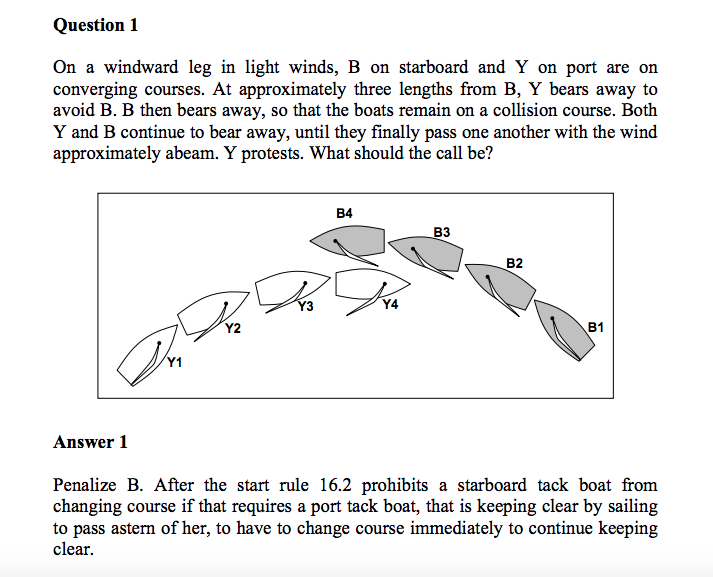
In the 2nd frame, Australia's angle appears to be about 8 degrees lower, and she is heeling noticeably more as a result of heading down. Note that in Call D2, Yacht B breaks 16.2 with a similarly small course change between positions B3 and B4. In the Olympic race, one of the Umpire boats is in a great position to see this, however Spain doesn't protest this incident (understandable as Spain is in the midst of a tricky maneuver - ducking, dialing up and tacking) resulting in either a Green Flag or no call from the Umpires.
Question 2: No Penalty. To understand this situation lets talk through it step by step, identify who has right of way, and what their obligations are.
*When Spain ducks Australia, Australia has right of way, she is on Starboard and Spain is on Port.
*When both boats cross head to wind, Spain now has right of way. The last sentence of Rule 13, While Tacking reads: "If two boats are subject to this rule at the same time, the one on the other's port side, of the one astern shall keep clear."
*When Austrailia reaches close hauled on port, she is now on a tack. Spain is not:
*The first sentence of Rule 13 reads: "After a boat passes head to wind, she shall keep clear of other boats until she is close hauled." So in this instant, Australia is right of way boat, and Spain is keep clear. This is critical.
*When Spain reaches a close hauled course on starboard tack, she is right of way boat, but subject to Rule 15 Acquiring Right of Way: "when a boat acquires right of way, she shall initially give he other boat room to keep clear."
The boats are so close at this point that Australia probably cannot keep clear by reversing tack:
*Spain allows Australia to keep clear by ducking the port tack boat, so there is no foul. The Umpires on this race made a really good, high pressure call!
Im going to show you one more Call from the Call book. The picture is a little different than what transpires here, but the italicized text at the bottom sums the above situation up perfectly:
"A boat acquiring right of way may comply with Rule 15 by altering course herself."
TR Call D3
PS: Spain went on to win the Gold Medal!! Regardless of the calls Umpires make, Sailors decide the races!!!
Warning: video contains graphic content for boat lovers!
The collision is between the J Boat Svea on Port tack and J Boat Topaz on Starboard. J class yachts raced for the Americas Cup from 1914 to 1937. They have a full keel with attached rudder and are therefore not very maneuverable, and also have long overhangs (bow and stern that project much longer than the waterline length) that swing as they turn.
Answers:
Well, since posting, the Protest Committee's ruling on this recent "viral" (no not that viral) video has been made public. Here are there facts found:
1. Topaz was approaching the start line on Starboard approximately 1 minute 40 seconds before the start. 2. Svea on port was on a collision course with Topaz. 3. Despite a last minute turn to bear away, Svea collided with the port side of Topaz at the runner winch causing serious damage. 4. Topaz luffed to avoid when it was clear Svea was not keeping clear. 5,6: There was extensive damage + injury - you can read the full decision here.
7. Both boats immediately retired from the race.
Decision: Svea took the appropriate penalty by retiring. Topaz is entitled to redress of average points for Race 1 based on her results in the remainder of the regatta.
Conclusion Rules:
RRS 10,14, 44.1(b) 62.1(b), Q5.3 Svea failed to keep clear as a port tack boat and broke rule 10, 14. It was not reasonably possible for Topaz to avoid the collision.
Its good for sailors to take note of Rule 62.1 (b), which allows for redress "based on a claim or possibility that a boat’s score or
place in a race or series has been or may be, through no fault of her
own, made significantly worse by...injury or physical damage because of the action of a boat that
was breaking a rule of Part 2 or of a vessel not racing that was
required to keep clear."
Otherwise, I have have 2 points of contention with the protest committee's decision in this case:
1. Are we sure (from the video) that "Svea was not keeping clear?"
2. Topaz did not "luff to avoid." In fact, the luff by Topaz made it significantly harder for Svea to keep clear.
By heading up, Topaz slows down, both from luffing the sails and the 'brakeing action' of her large rudder. She also swings her long overhang at Svea, making the point of contact occur sooner. Here's a 3d rendering of Svea that illustrates the overhangs and the rudder:
The overhang is massive and obviously has no flow and traction through the water - it just pivots through the air as the boat turns - especially at slow speeds. The contact from the collision occurs aft of Topaz's rudder. If Topaz had not headed up it is certain the contact would have occurred further aft, and at a more glancing angle than the full on T-bone shown in the video.
Rule 16.1 States: When a right-of-way boat changes course, she shall give the other
boat room to keep clear. Regardless of if Svea was "keeping clear" of Topaz, Topaz change of course made keeping clear more difficult.
The Call Book for Team Racing gives 2 examples where a late course change by a starboard boat is prohibited. In the comments section Justin Callahan cited Call D2:
The call doesn't explicitly apply to this situation, as Rule 16.2 only applies after the start. However, if there is contact at position 4, I think it is implied that B would have broken 16.1. This next call specifically shows a starboard boat (Y) swinging her stern towards a port tack boat (B), necessitating a further course change.
Call D7 :
In this case, the Call Book says to penalize Y, again for 16.2. If there had been contact (rather than B having to further change course at the last second), I am confident Y would have also broken 16.1 - she would have changed course in a way that did not give B "room to keep clear."
Given that Topaz luff exacerbated the contact, can we be sure that Svea was never keeping clear? A couple notes on this possibility:
* The J boat from which the video is shot shows that each boat has a bow watch who relays info to the cockpit via a crew member stationed at the windward shroud.
* Sailing on Port before the start one is always on the lookout for boats on Starboard.
* Svea would have seen Topaz before Topaz saw Svea.
* Before the contact, Svea is clearly letting out her mainsail in an attempt to duck Topaz.
*A 3rd party observer on the boat that is filming does not begin shouting "noooo!" until Topaz is changing course.
Still, I have to give some credence to Judges determination that Svea "...was not keeping clear," and "It was not reasonably possible for Topaz to avoid the collision." They heard evidence from both parties, and some Judges reportedly witnessed the incident from Judgeboats.
Does it matter if Topaz changes course if Svea was never keeping clear? May a right of way boat alter course as long as she is on a collision course with a keep clear boat? I hope not! By changing course in a way that put her hull further in Sveas path, Topaz made it impossible for Svea to even have a chance of keeping clear. Therefore, I think from this video that both boats should have been penalized - Svea for Rule 10 and Topaz for Rule 16.1. Topaz was right of way, and Topaz changed course very close to Svea in a manner that did not "give the other boat room to keep clear" . If the Judges (who again have more information than this video) did not state that Svea "was not keeping clear," then I would be inclined to penalize only Topaz for 16.1.
I strongly disagree with the Scuttlebutt article titled "When in doubt put the tiller towards trouble" which argues that Topaz helmsman "did the understandable thing in the few seconds they had to deal with an impending collision which is to put the “tiller towards trouble.” When a boat is trying to duck you, heading up at the last second is the worst thing you can do. When a boat is clearly trying to duck you, maintain your speed and hold your course!
Regatta Debrief blogs are back! Sorry for the long hiatus. As always, these are part narrative, part technical debriefs for sailors, parents and coaches!
I remember Junior Olympics growing up - it was the biggest regatta of our short summer season in Maine and we would spend days packing our boats and going over our gear in anticipation. I remember the disappointment in 2004, in Portland, ME, when the Race Committee abandoned the only light air Club 420 race after 5 boats, myself and crew included had finished. We filed for class-action redress asking to count the race but were denied by the protest committee, and with no wind the next day there was no regatta! After managing 7th in 2003 and winning 'the race that didn't count' we felt robbed of a JR Olympics!
Today the Opti kids on the Florida circuit have more consequential events, like Team Trials, Nationals and the International events they sail including Orange Bowl. But the Junior Olympics is still special because of its US Sailing designation and Multi-class flavor! The Opti fleet of 126 active boats was impressive in size and local talent!
Packing for this event began the Sunday before Thanksgiving, but many sailors packed their boats in a myriad of ways over the holiday break. The LYC Opti Trailer + Truck has 22 spots and given that 9 LYC Green Fleeters attended the event, that meant that much of champ fleet had to get their boats to the regatta by other means. 3 Families with sailing siblings have now acquired multi-opti trailers that together haul 8 more boats! The sailors and coaches appreciate these and other parents who carried Optis in their pickup trucks or on their roof-racks to help get the team to the regatta!
The sailors had a weekend off from sailing before the regatta, and put some thought into making sure all their equipment got there. At least 7 sailors did after school practice sessions the week leading up to get back into the feel of the Opti with coaching from Pilo, Mauricio or myself; others took advantage of the full break! On Friday, we drove up I95 and arrived at the US Sailing Center in Martin County just before 2pm, splashed coach boats and started rigging.
The sailors all checked their mast rake - sometimes this moves a little while in transit. This is measured with a tape measure led from the top of the mast to the top of the transom. It was great to see most of my silver fleeters had brought their own tape measure, and many had a zip-tie through the end-piece, which really helps the Tape stay hooked in the top of the mast!
Why does mast rake matter? The primary effect of the rake is to place the center of effort of the boat. Rake forward, center of effort is forward. This effects the balance of the boat and helm upwind (‘helm’means the push or pull the sailor feels on the rudder). The secondary effect of rake is to change the boom height, which in turn changes the sheeting angle, feel of trimming the sail, and the amount of twist in the leech of the sail for a given sheeting angle. We encourage sailors to experiment with mast rakes within a given range (110”-111.5” for most sailors) and to move their rake on the water if they feel that the balance of the boat needs adjusting. That said, you need to have some consistency especially for less experienced sailors as again, the Sail looks different and trims different at different rakes. For example, we have had some larger, fast sailors in the past sailing fast at 112” (raked forwards, boom up), but they were adept at playing the mainsheet and took care not to stall the leech. Bella Cassaretto (Orange Bowl ‘16 champ) was the master of raking pretty far forward, heeling slightly to windward, yet still keeping her leech open with pressure in the sail, the fluttering leech telltale visible from my coachboat.
We stress the tuning process at LYC, and if you get your boom-ties and top-diagonal corner-tie right on the practice day you will not have to re-tie them for the rest of the regatta! We stress the overall importance of everything in the boatpark. Pilo likes to say “show the respect” to other competitors, which I think means both be respectful and demand their respect. Being polite but assertive when setting up your equipment keeps it from getting damaged and shows the rest of the fleet which sailors take their tuning and boatspeed seriously! We have a special routine for how we rig the sails (see rigging section in this past blog post), and sailors learn to find a dry, clean, temperature appropriate (rigging in the shade if its hot for example) spot to set the sail up. If there is really nowhere to rig or all the grass is wet you can set up the sail on top of the Opti, getting the corner-ties, preventer, vang and sprit all tight to stretch the sail and make it solid. When it comes time to launch, respect the rules and instructions of volunteers, but be creative with how you can get yourself and teammates to the beach. If an unattended Opti is blocking you, you may move it with extreme care.
The LYC sailors did a great job being ready and launching on-time. With my Silver fleet there was never one sailor holding up the towline and we got to the course both days right behind the Gold fleet tow line. Both LYC groups were among the first ones out practicing in the racing area and used the time to their advantage. A benefit of Ocean practice at LYC is that the sailors get really good at towing! Towing can at first be scary to Opti sailors, but like sailing, it is all about balancing the boat. You have to trim the sail in to keep pressure in it and on your foils. Then you can sit opposite the sail. If the towline is moving on a reach, let your sail out to a close reaching angle. If the coach is towing the Optis close hauled or above, then the sailor should pull the boom out to windward, still keeping the mainsheet tight to put downward tension on the sail as well. You can actually hike out with the boom balancing your weight!
Jack gets the hang of “wind surfing” to keep his sail full on one of his first trips to the ocean! More sprit needed to stiffen the top of the sail.
Drew acknowledged for his towline readiness.
I don't tow sailors directly in to the wind - luffing the sails and the aging it causes is not worth the extra time. I will tow on a close hauled course and tack the tow line, trying to play the wind-shifts and current! At this point in the season this is all old news to the LYC sailors; they were all towing trimmed in hard, with weight forward and to windward balancing the sail - no airbag loungers!! With well prepared and maintained bowlines, and sunglasses for safety we were able to tow at a pretty fast speed over the long tow to the racing area north of the Bridge.
Saturday brought a light wind from the North that shifted to North east by the end of the day. The current was originally ebbing from the North, but went slack and then reversed around 1pm. The fleet could not get a clean start. The first 2 attempts under prep and U flag more than half the fleet was over the line! The line was relatively short for the 126 boats and square to the wind on average. It was apparent after the 2nd recall that the RC would go to Black Flag starting procedure, thus beginning the game of “is this a real start?”. The game is this: If a Black Flag start is going to be a General Recall, then there is nothing to be gained by being over - only the downside of a DSQ if the Race Committee sees you. So don't be over on a general recall!! I encouraged sailors to try to sniff out in the last 1:30 if the fleet was going to be over, and if soo to be very cautious! A port tack approach to a pin end start gives you a really good view of the fleet and line sag/line bulge before you commit to a spot on the line. Over the next hour and a half there were 3-4 more general recalls under Black Flag, and a lot of sailors kicked out. RC shows the Boats recorded BFD who can’t sail in the upcoming race Fortunately, and through prudence and reading the line only 1 LYC sailor was identified as over of all the general recalls! Luca Damiano read his number on the RC’s dry erase board board and we anchored his boat so he could watch the race with me from the Coachboat.
A postponed start from the pin with coaches commentary.
Unfortunaly on the start that was finally allowed to go (the RC felt they had all of the sailors over identified) 3 more LYC sailors were caught BFD. However, I look at this as almost a “smart” BFD because they were trying to get a good start on a race that most sailors were on the line. I was able to watch down the line and saw Drew and James over near the committee boat by just a few inches! They were not happy to learn of the BFD back on land, but got to sail a good race and there was at least some upside to their gamble.
The race started in a left phase shift that made the Pin end favored by about 10 degrees. As such the boats that started at the committee boat - KJ,Ty, James, Matthew and Drew could not cross the fleet on starboard and tacked out towards the right. They still had clear air and leverage on the fleet and hoped for a right hand shift along the barrier-island shoreline to put them ahead. Lulu and Gil started well towards the Pin end and consolidated a little bit on the fleet before again leading out to the left. Sailing up the middle seldom works in light wind and I thought the leaders on both sides played their area well and were patient before coming back to the middle. The left side won out and though Lulu appeared to be in the lead Gil caught a puff on the port layline to round first with Lulu 3rd. Lulu eased her outhaul on port tack, reaching under the boom as she sailed into the mark, and used the extra full sail to motor on both downwind legs - getting launched into 2nd and making Gil nervous! Cody and KJ had nice comebacks and Mariano and Pierce sailed good races as well. Mateo crossed the line in 4th but was unfortunately Black Flagged!
Cody eases his outhaul as he rounds the Windward mark making a fuller sailshape for the downwind legs
Gill/Lulu lead race 1 at the leeward mark. Lulu has already re-tightened her sprit for the upwind leg.
It was a long day on the water, especially for one race, and the sun was low as we made the long tow in. The volunteers at the US Sailing Center were ready with a burger cookout for hungry sailors! Pilo let the Gold Fleet go as we would have a very early start tomorrow, while Mauricio and I did a short debrief with Silver and Bronze - we wanted to give some guidance on how to reflect on your day.
Gil starts the second upwind leg by scanning the race course for where he sees more wind.
Sunday I walked outside of the coach’s Airbnb to dark and a drizzle. The USSC’s grassy boat park had the potential to turn into a Woodstock ’69 level mud pit, but fortunately the rain stopped as the sun came up. We were happy to see manny of our sailors among the first ones there in advance of the 7:45am rigged and ready time. There was no “Harbor Start” which I liked- the sailors and coaches had to time getting out before the 9:30am Race Start north of the bridge, and could get out as early as they wanted - more regattas should do this!! We launched, towed out to the racing area on a screaming reach, and began tuning up in a brisk 12 kt Easterly.
The 3 races we completed on Sunday were each unique. The first race was sailed mainly in a light - 7-8kt “gradient” wind. The gradient wind comes from the ENE and is the result of the earth turning! Gradient wind is weak enough to prevail only in the absence of other wind - frontal or thermal breeze for example. The second and 3rd races on Sunday had wind that was influenced by rain clouds moving through the racing area. Rain displaces air so “rain clouds blow” is an easy way to think about their effect. Clouds without rain do the opposite, creating a cool vacuum underneath them that sucks air to it - so its important to look and see if its raining underneath the clowds upwind of the racing area!
After a Black Flag general recall the 2nd race of the regatta was underway. In light air and somewhat shifty wind it was all about getting a good start and playing the windshifts. A last lefty before the windward mark put SPYC’s Dorthy Mendelblatt in the lead with Ty Lamm in 2nd. Another shifty last beat and Ty got the horn! Gil Hackel had a good run, jibing to separate from the rest of the 5-10 pack and focusing on speed and kiting. He came back to 5th to maintain the regatta lead. Drew Lamm shook off yesterdays BFD and got a 4th.
In the next race around the time of the start a rain cloud became apparent above the top right side of the race course. The wind had already shifted to the right - due East now. There was a brief left oscillation after the start that allowed Gil to work towards the right of the course, but many boats that started towards the pin stayed left and would pay a heavy price! Luca Damiano had one of his best starts mid-boat but unfortunately didn't tack at the first opportunity and continued to sail through the middle towards the left. Skye Johnson and CRYC’s Freddie Parkin were among the only ones to focus on the rain cloud and played hard to the right. At this point it was still light wind and the sailors were mostly sitting in their boats. Then the wind began to build and shift right as the rain got nearer. Skye, Freddie and Gil, just on the outside edge of the shift but still getting it were wound up and up and up on starboard tack as a light drizzle just before the windward mark confirmed what was happening! Gil passed Freddie just before the windward mark, Jybed into the righty of the run and sailed defensively to win the race with Freddie 2nd. Skye rounded the windward mark 5th and finished 7th. For Cody, James and others on the left of the course its was a disaster! Its a tough situation - hoping and thinking the breeze will shift back your way because it has been oscillating all day/regatta, only for the persistent shift to hold! The lesson I would take going forwards is to look more at the clouds!
I should note that the breeze built with the onset of rain to 15kts on the last leg. At this point you are tuned for light air and you just have to hike it out! Some sailors left their sprit loose from the downwind leg to de-power which worked. It wasn't that long of a last beat so you just have to deal with the conditions and keep your eyes on the prize! Moving from 45 to 43 might not seem as glamorous as moving from 3rd to first but the points you save are the same given that there would not be a throwout!
Drew rocks the last leg with (maybe a little too) eased sprit. Note his minimalist grip on the extension- the helm is balanced by his hiking.
After race 2 there was a fairly long break - the rain passed to leeward which caused a lull. For a while the wind was unsailably light and from the South-West - an unsustainable direction. Fortunately another rain cloud gave us wind for the final race of the regatta! As the pressure built from the SE the LYC sailors that tunes up in the middle of the racing area got a feel for the wind shifts. As the rain-cloud appeared to be directly upwind of the windward mark, I told the sailors I spoke with not to expect a major shift and to play the oscillations. Gil had a target finish of top 8 to win the regatta and Freddie and Matias Martin to keep tabs on, while everyone else was just going for the best finish possible! Largely due to the tune up before the race and after the delay, LYC as a whole had our best race of the regatta. Coming from the middle left with good starts, speed, and in phase with the wind-shifts 6 LYC sailors rounded in the top 10. Gil stayed right just long enough to force Freddy further to that side but did give up some places with too many tacks and by Jybing around Mark 2 (wrong move this time!) Mateo Coates and Drew Lamm finished 1,2 - they had enough of a lead on 3rd for a short tacking duel just before the finish in which Mateo protected the right and just held Drew off.
It was great to see these sailors, who both had Saturday Black Flags holding their result back overall show what they can do! Ana Smith also notched her beast race to date and the RC was very nice to grant her “Scoring inquiry” after the protest deadline and reinstate her 17th. Final top overall results for LYC were Gil 1st, Ty 4th, Lulu 5th, Cody 10th, KJ 16th, Skye 23rd, Ana 29th, and Mateo and Drew 31 and 32 even with the Black Flags. From LYC’s Bronze fleet Alie Capasso (46th) Mariano Vega (59th even with a BFD!) and Natail Sorbo had good events! Overall the coaches were happy with the kids focus, work ethic and improvement and we are excited for 6 more days of training to see what strides we can make going into Orange Bowl!
The 2019 US Optimist Team Trials is in the books and it was a landmark success for the sailors from Lauderdale Yacht Club. LYC’s Tommy Sitzman (Annapolis, MD) came in as the favorite, having qualified last year and placed 5th at the 2018 Worlds, and he won 6 of 12 races and finished atop the podium. LYC’s Gil Hackel (Pensacola, FL) finished 3rd and became one of the youngest sailors ever to qualify for Worlds from the USA at age 11. He also won 6 races. LYC’s Jack Redmond (Ft. Lauderdale, FL) won 4 races and finished 4th. Joining these 3 LYC sailors on the Worlds team are Samara Walshe (Edgertown Yacht Club -LISOT) and Thommie Grit (Sarasota YS/CERT) - 2nd and 5th respectively. LYC’s success went far beyond the top 5 as Tyler Lamm Finished 10th, Jake Homberger 14th, Drew Lamm 16th, KJ Hill 18th, and Nico Garcia-Castrillon 21st. At least 11 LYC sailors should receive invitations to the US National Team of 36.
This years Team Trials was contested in Marina Del Rey, California, westward of the Venice Beach Pier on the Pacific Ocean. The conditions were essentially “Groundhog Day” - always the same 7-10kt seabreeze from the South-West. 12 races were sailed, 3 a day like clockwork by PRO Bill Stump. The 193 boats in attendance all had to qualify by placing in well in previous USODA Regattas over the last 11 months, making Team Trials the toughest Opti regatta in the US each year! The fleet was split into 3 equal divisions for 3 days (divisions re-balanced every day) and a Gold fleet of the top 1/3rd for the final day.
Gil Hackel (21447) and Ty Lamm (19458) Lead the fleet downwind in the Pacific Swells
With a lot of top sailors dominating in their divisions through qualifying it made for high drama on the final day of racing, with 8 sailors realistically in contention for Opti Worlds - to be held this summer in Antigua. Jack Redmond made a great opening statement with a 3rd in the 1st race and solidified his position. Tommy and Gil had impressive comeback’s in races where they didn't round in the top of the fleet and Gil had clinched at least 4th place before the start of the final race. He sailed with no pressure to a 3rd, and Sitzmann came all the way back from the 20’s to a regatta clinching 7th. Thommie Grit, Griggs Diemar (CRYC) and Parker Tyson (CRYC) all battled for the final Worlds berth on the last race, with Grit and Griggs fighting for position at the gate, and, after splitting on the last beat, again just before the finish. Diemar and Tyson will likely represent the USA at the European Championships.
Tommy Sitzman (22229) rounds mark 2 in the lead en route to winning Team Trials.
Note the eased outhaul for faster downwind sailing!
With 4 days of on-site practice and expert coaching from Pilo Rocha, Arthur Blodgett and Argie Resano the LYC team was well prepared. Towing each day past seals and sea-lions, racing and competing with friends it was a great experience for the sailors and they responded by putting everything into their races - the team had been focused on training for this event for 8 months and was ready to see the work pay off. 14 of the 19 LYC sailors made the top 1/3rd Gold Fleet, including Graceanna Dixon and Cole Fanchi at their first Team Trials, and Cole even made the national team at age 11! We return to South Florida tired from the long days, a little jet lagged, but super happy and proud at what the sailors in our community achieved against the best national competition.
Top 10 overall at Awards at the California Yacht Club. From Left: Tyler Lamm, Pearse Dowd, Griggs Diemar, (not pictured Samara Walshe), Tommy Sitzamnn, Gil Hackell, (not pictured Jack Redmond), Thommie Grit, Parker Tyson, and Katherine Doble.
As we focus on Boat-handeling and prepare for this year's Team Race Midwinters, here's some tacks from last years LYC1 team that attended the Marco Rizzotti Team Race in Italy. 3 of the sailors featured (Stephan Baker, Sara Schumann, Ryan Konrad) have since moved on to bigger boats, and Lulu and Jack's tacks have continued to improved since then! Fun to look back on and interesting to see several different sizes of sailors with different footwork and tacking styles, all practicing with focus and making it work for them! Thanks always to Neil Young for the music!
Key points for analyzing your own roll tacks - ask yourself these questions!:
1. The Turn:
- Is the turn smooth? (turn through the wind slower in flat water, faster in waves).
- Do I pump in the mainsheet in a way that makes the boat head up, and propells it into the wind?
- Are my eyes on the sail until the last possible split second?
2. The Roll:
- Am I rolling at the right time (when the front half of the sail luffs)?
- Am I rolling enough? Often if you don't get enough roll its because you went out too early.
- Am I keeping my weight forward while I roll?
- Are my knees together for a compact, athletic position to spring from?
- Am I keeping the sail cranked in to stop it from luffing?
3. The Flatten:
- Am I landing forwards?
- Easing the sail as the boat flattens?
- Getting my eyes on the telltales ASAP?
- Trimming back in when the boat is flat?
-Switching hands AFTER the boat is flat and all mainsheet action finished.
-Flattening the right amount/smoothness for the conditions! If its windy, flatten with your butt on the rail! If its light, land softly - big splashes are slow and overly aggressive tacks more likely to be flagged by the umpires.
A few notes on the Rules & roll-tacking: - Rule 42.3 (b) begins: "A boats crew may move their bodies to exaggerate the rolling that facilitates steering the boat through the tack or gybe..." So roll tacking is legal. -Rule 42.1 provides that the "...crew may adjust the trim of the sails and hull." The mainsheet ease that we coach the kids to do as they are flattening is adjusting the sail to the actual apparent wind angle - if you DONT let out the sail at that point it stalls!
So there are 2 potential way these tacks could infringe on rule 42, one logical, one subjective:
- Rule 42.2 (e) lists as a prohibited action: "repeated tacks or gybes unrelated to the wind or to tactical considerations." Makes sense.
And then the subjective: - The latter part of Rule 42.3 (a) says roll-tacks are legal, "provided that, just after the tack or gybe is completed, the boat's speed is not greater than it would have been in the absence of the tack or gybe."
"Than it would have been." This is a phrase requiring the umpire's imagination! As the great Chris Williford once said to me "Hindsight is always 50/50." Hard to know how it would have been. Until we give Umpires radar guns this is a very subjective call, and I applaud College Sailing for modifying out this part of Rule 42! Any well tacked yacht is going to accelerate from head to wind to out of the tack, so its a tough judgement of exit speed vs imagined "absence of the tack" speed. If the umpire crew is enforcing this aggressively, then I coach the kids to flatten even more smoothly/slowly in order to 'pace out the acceleration' - make it less sudden. Breaking rule 42 is an "Umpire initiated penalty" in Team Racing and the umpires are a really important part of the game - we applaud them for policing sculling, double pumps, plus all the other rules (!) and for the time, energy and expertise they put towards making Team Racing regattas awesome! All good sailors should try umpiring some time - it will give you an incredible perspective!