Friday, December 13, 2019

Regatta Debrief - Junior Olympics

https://drive.google.com/uc?export=view&id=1JkHvdojvAYvNow7DxsviuoECsFBZ8f99

Regatta Debrief blogs are back! Sorry for the long hiatus. As always, these are part narrative, part technical debriefs for sailors, parents and coaches! 


I remember Junior Olympics growing up - it was the biggest regatta of our short summer season in Maine and we would spend days packing our boats and going over our gear in anticipation. I remember the disappointment in 2004, in Portland, ME, when the Race Committee abandoned the only light air Club 420 race after 5 boats, myself and crew included had
finished. We filed for class-action redress asking to count the race but were denied by the protest committee, and with no wind the next day there was no regatta! After managing 7th in 2003 and winning 'the race that didn't count' we felt robbed of a JR Olympics! 

Today the Opti kids on the Florida circuit have more consequential events, like Team Trials, Nationals and the International events they sail including Orange Bowl. But the Junior Olympics is still special because of its US Sailing designation and Multi-class flavor! The Opti fleet of 126 active boats was impressive in size and local talent! 


Packing for this event began the Sunday before Thanksgiving, but many sailors packed their boats in a myriad of ways over the holiday break. The LYC Opti Trailer + Truck has 22 spots and given that 9 LYC Green Fleeters attended the event, that meant that much of champ fleet had  to get their boats to the regatta by other means. 3 Families with sailing siblings have now acquired multi-opti trailers that together haul 8 more boats! The sailors and coaches appreciate these and other parents who carried Optis in their pickup trucks or on their roof-racks to help get the team to the regatta! 

The sailors had a weekend off from sailing before the regatta, and put some thought into making sure all their equipment got there. At least 7 sailors did after school practice sessions the week leading up to get back into the feel of the Opti with coaching from Pilo, Mauricio or myself; others took advantage of the full break! On Friday, we drove up I95 and arrived at the US Sailing Center in Martin County just before 2pm, splashed coach boats and started rigging. 

The sailors all checked their mast rake - sometimes this moves a little while in transit. This is measured with a tape measure led from the top of the mast to the top of the transom. It was great to see most of my silver fleeters had brought their own tape measure, and many had a zip-tie through the end-piece, which really helps the Tape stay hooked in the top of the mast! 

Why does mast rake matter? The primary effect of the rake is to place the center of effort of the boat. Rake forward, center of effort is forward. This effects the balance of the boat and helm upwind (‘helm’ means the push or pull the sailor feels on the rudder). The secondary effect of rake is to change the boom height, which in turn changes the sheeting angle, feel of trimming the sail, and the amount of twist in the leech of the sail for a given sheeting angle. We encourage sailors to experiment with mast rakes within a given range (110”-111.5” for most sailors) and to move their rake on the water if they feel that the balance of the boat needs adjusting. That said, you need to have some consistency especially for less experienced sailors as again, the Sail looks different and trims different at different rakes. For example, we have had some larger, fast sailors in the past sailing fast at 112” (raked forwards, boom up), but they were adept at playing the mainsheet and took care not to stall the leech. Bella Cassaretto (Orange Bowl ‘16 champ) was the master of raking pretty far forward, heeling slightly to windward, yet still keeping her leech open with pressure in the sail, the fluttering leech telltale visible from my coachboat. 

We stress the tuning process at LYC, and if you get your boom-ties and top-diagonal corner-tie right on the practice day you will not have to re-tie them for the rest of the regatta! We stress the overall importance of everything in the boatpark. Pilo likes to say “show the respect” to other competitors, which I think means both be respectful and demand their respect. Being polite but assertive when setting up your equipment keeps it from getting damaged and shows the rest of the fleet which sailors take their tuning and boatspeed seriously! We have a special routine for how we rig the sails (see rigging section in this past blog post), and sailors learn to find a dry, clean, temperature appropriate (rigging in the shade if its hot for example) spot to set the sail up. If there is really nowhere to rig or all the grass is wet you can set up the sail on top of the Opti, getting the corner-ties, preventer, vang and sprit all tight to stretch the sail and make it solid. When it comes time to launch, respect the rules and instructions of volunteers, but be creative with how you can get yourself and teammates to the beach. If an unattended Opti is blocking you, you may move it with extreme care. 

The LYC sailors did a great job being ready and launching on-time. With my Silver fleet there was never one sailor holding up the towline and we got to the course both days right behind the Gold fleet tow line. Both LYC groups were among the first ones out practicing in the racing area and used the time to their advantage. A benefit of Ocean practice at LYC is that the sailors get really good at towing! Towing can at first be scary to Opti sailors, but like sailing, it is all about balancing the boat. You have to trim the sail in to keep pressure in it and on your foils. Then you can sit opposite the sail. If the towline is moving on a reach, let your sail out to a close reaching angle. If the coach is towing the Optis close hauled or above, then the sailor should pull the boom out to windward, still keeping the mainsheet tight to put downward tension on the sail as well. You can actually hike out with the boom balancing your weight!

https://drive.google.com/uc?export=view&id=1fOm7JX1wAX9XO09Vlrl7z-x8i6sK7eRRJack gets the hang of “wind surfing” to keep his sail full on one of his first trips to the ocean! More sprit needed to stiffen the top of the sail. https://drive.google.com/uc?export=view&id=14qcwkdtwrceeLsmTM7AEVWZdqMH4bNjG
Drew acknowledged for his towline readiness. 

 I don't tow sailors directly in to the wind - luffing the sails and the aging it causes is not worth the extra time. I will tow on a close hauled course and tack the tow line, trying to play the wind-shifts and current!  At this point in the season this is all old news to the LYC sailors; they were all towing trimmed in hard, with weight forward and to windward balancing the sail - no airbag loungers!!  With well prepared and maintained bowlines, and sunglasses for safety we were able to tow at a pretty fast speed over the long tow to the racing area north of the Bridge. 


Saturday brought a light wind from the North that shifted to North east by the end of the day. The current was originally ebbing from the North, but went slack and then reversed around 1pm.  The fleet could not get a clean start. The first 2 attempts under prep and U flag more than half the fleet was over the line! The line was relatively short for the 126 boats and square to the wind on average. It was apparent after the 2nd recall that the RC would go to Black Flag starting procedure, thus beginning the game of “is this a real start?”. The game is this: If a Black Flag start is going to be a General Recall, then there is nothing to be gained by being over - only the downside of a DSQ if the Race Committee sees you. So don't be over on a general recall!!  I encouraged sailors to try to sniff out in the last 1:30 if the fleet was going to be over, and if soo to be very cautious! A port tack approach to a pin end start gives you a really good view of the fleet and line sag/line bulge before you commit to a spot on the line. Over the next hour and a half there were 3-4 more general recalls under Black Flag, and a lot of sailors kicked out.https://drive.google.com/uc?export=view&id=1Rge4miKeNS7zbTQ_8FPHlgfjXSlo7Sjo
RC shows the Boats recorded BFD who can’t sail in the upcoming race 
 Fortunately, and through prudence and reading the line only 1 LYC sailor was identified as over of all the general recalls! Luca Damiano read his number on the RC’s dry erase board board and we anchored his boat so he could watch the race with me from the Coachboat. 

A postponed start from the pin with coaches commentary.

Unfortunaly on the start that was finally allowed to go (the RC felt they had all of the sailors over identified) 3 more LYC sailors were caught BFD. However, I look at this as almost a “smart” BFD because they were trying to get a good start on a race that most sailors were on the line. I was able to watch down the line and saw Drew and James over near the committee boat by just a few inches! They were not happy to learn of the BFD back on land, but got to sail a good race and there was at least some upside to their gamble. 

The race started in a left phase shift that made the Pin end favored by about 10 degrees. As such the boats that started at the committee boat - KJ,Ty, James, Matthew and Drew could not cross the fleet on starboard and tacked out towards the right. They still had clear air and leverage on the fleet and hoped for a right hand shift along the barrier-island shoreline to put them ahead. Lulu and Gil started well towards the Pin end and consolidated a little bit on the fleet before again leading out to the left. Sailing up the middle seldom works in light wind and I thought the leaders on both sides played their area well and were patient before coming back to the middle. The left side won out and though Lulu appeared to be in the lead Gil caught a puff on the port layline to round first with Lulu 3rd. Lulu eased her outhaul on port tack, reaching under the boom as she sailed into the mark, and used the extra full sail to motor on both downwind legs - getting launched into 2nd and making Gil nervous! Cody and KJ had nice comebacks and Mariano and Pierce sailed good races as well. Mateo crossed the line in 4th but was unfortunately Black Flagged! 
https://drive.google.com/uc?export=view&id=1JJOgZFcA337vjNuOYasWnQdOZ4aLiD2D
Cody eases his outhaul as he rounds the Windward mark making a fuller sailshape for the downwind legs


https://drive.google.com/uc?export=view&id=17FMfIAq3JODUxbvkKvOjYuTZEg_YDl7h
Gill/Lulu lead race 1 at the leeward mark. Lulu has already re-tightened her sprit for the upwind leg. 

It was a long day on the water, especially for one race, and the sun was low as we made the long tow in. The volunteers at the US Sailing Center were ready with a burger cookout for hungry sailors! Pilo let the Gold Fleet go as we would have a very early start tomorrow, while Mauricio and I did a short debrief with Silver and Bronze - we wanted to give some guidance on how to reflect on your day.
https://drive.google.com/uc?export=view&id=1KhkLI_b9StDjvcMelY0QekrjSlB2cXqG
Gil starts the second upwind leg by scanning the race course for where he sees more wind.

Sunday I walked outside of the coach’s Airbnb to dark and a drizzle. The USSC’s grassy boat park had the potential to turn into a Woodstock ’69 level mud pit, but fortunately the rain stopped as the sun came up. We were happy to see manny of our sailors among the first ones there in advance of the 7:45am rigged and ready time. There was no “Harbor Start” which I liked- the sailors and coaches had to time getting out before the 9:30am Race Start north of the bridge, and could get out as early as they wanted - more regattas should do this!! We launched, towed out to the racing area on a screaming reach, and began tuning up in a brisk 12 kt Easterly. 

The 3 races we  completed on Sunday were each unique. The first race was sailed mainly in a light - 7-8kt “gradient” wind. The gradient wind comes from the ENE and is the result of the earth turning! Gradient wind is weak enough to prevail only in the absence of other wind - frontal or thermal breeze for example. The second and 3rd races on Sunday had wind that was influenced by rain clouds moving through the racing area. Rain displaces air so “rain clouds blow” is an easy way to think about their effect. Clouds without rain do the opposite, creating a cool vacuum underneath them that sucks air to it - so its important to look and see if its raining underneath the clowds upwind of the racing area! 

After a Black Flag general recall the 2nd race of the regatta was underway. In light air and somewhat shifty wind it was all about getting a good start and playing the windshifts. A last lefty before the windward mark put SPYC’s Dorthy Mendelblatt in the lead with Ty Lamm in 2nd. Another shifty last beat and Ty got the horn! Gil Hackel had a good run, jibing to separate from the rest of the 5-10 pack and focusing on speed and kiting. He came back to 5th to maintain the regatta lead. Drew Lamm shook off yesterdays BFD and got a 4th. 

In the next race around the time of the start a rain cloud became apparent above the top right side of the race course. The wind had already shifted to the right - due East now. There was a brief left oscillation after the start that allowed Gil to work towards the right of the course, but many boats that started towards the pin stayed left and would pay a heavy price! Luca Damiano had one of his best starts mid-boat but unfortunately didn't tack at the first opportunity and continued to sail through the middle towards the left. Skye Johnson and CRYC’s Freddie Parkin were among the only ones to focus on the rain cloud and played hard to the right. At this point it was still light wind and the sailors were mostly sitting in their boats. Then the wind began to build and shift right as the rain got nearer. Skye, Freddie and Gil, just on the outside edge of the shift but still getting it were wound up and up and up on starboard tack as a light drizzle just before the windward mark confirmed what was happening! Gil passed Freddie just before the windward mark, Jybed into the righty of the run and sailed defensively to win the race with Freddie 2nd. Skye rounded the windward mark 5th and finished 7th. For Cody, James and others on the left of the course its was a disaster! Its a tough situation - hoping and thinking the breeze will shift back your way because it has been oscillating all day/regatta, only for the persistent shift to hold! The lesson I would take going forwards is to look more at the clouds! 
https://drive.google.com/uc?export=view&id=1pw6Llr-PKijA9gWDjMFnq2lPSNpLoHHN
I should note that the breeze built with the onset of rain to 15kts on the last leg. At this point you are tuned for light air and you just have to hike it out! Some sailors left their sprit loose from the downwind leg to de-power which worked. It wasn't that long of a last beat so you just have to deal with the conditions and keep your eyes on the prize! Moving from 45 to 43 might not seem as glamorous as moving from 3rd to first but the points you save are the same given that there would not be a throwout! 
https://drive.google.com/uc?export=view&id=17o6nhWqzCxJDZ1q7VJfJsugLX1crAdG1
Drew rocks the last leg with (maybe a little too) eased sprit. Note his minimalist grip on the extension- the helm is balanced by his hiking. 

After race 2 there was a fairly long break - the rain passed to leeward which caused a lull. For a while the wind was unsailably light and from the South-West - an unsustainable direction. Fortunately another rain cloud gave us wind for the final race of the regatta! As the pressure built from the SE the LYC sailors that tunes up in the middle of the racing area got a feel for the wind shifts. As the rain-cloud appeared to be directly upwind of the windward mark, I told the sailors I spoke with not to expect a major shift and to play the oscillations. Gil had a target finish of top 8 to win the regatta and Freddie and Matias Martin to keep tabs on, while everyone else was just going for the best finish possible! Largely due to the tune up before the race and after the delay, LYC as a whole had our best race of the regatta. Coming from the middle left with good starts, speed, and in phase with the wind-shifts 6 LYC sailors rounded in the top 10. Gil stayed right just long enough to force Freddy further to that side but did give up some places with too many tacks and by Jybing around Mark 2 (wrong move this time!) Mateo Coates and Drew Lamm finished 1,2  - they had enough of a lead on 3rd for a short tacking duel just before the finish in which Mateo protected the right and just held Drew off. 


It was great to see these sailors, who both had Saturday Black Flags holding their result back overall show what they can do! Ana Smith also notched her beast race to date and the RC was very nice to grant her “Scoring inquiry” after the protest deadline and reinstate her 17th. Final top overall results for LYC were Gil 1st, Ty 4th, Lulu 5th, Cody 10th, KJ 16th, Skye 23rd, Ana 29th, and Mateo and Drew 31  and 32 even with the Black Flags. From LYC’s Bronze fleet Alie Capasso (46th) Mariano Vega (59th even with a BFD!) and Natail Sorbo had good events! Overall the coaches were happy with the kids focus, work ethic and improvement and we are excited for 6 more days of training to see what strides we can make going into Orange Bowl! 
https://drive.google.com/uc?export=view&id=1YqQt8mKCvGFrRJSkAXQ2ucbNStLQeSHVhttps://drive.google.com/uc?export=view&id=17-Bq-Nkhdm0SjdGrBfQSbWBxhXOFQDMz

Thursday, May 9, 2019

LYC Sailors Crush Opti Team Trials

Jack Redmond (22280) lays down a saucy Roll Tack.

The 2019 US Optimist Team Trials is in the books and it was a landmark success for the sailors from Lauderdale Yacht Club. LYC’s Tommy Sitzman (Annapolis, MD) came in as the favorite, having qualified last year and placed 5th at the 2018 Worlds, and he won 6 of 12 races and finished atop the podium. LYC’s Gil Hackel (Pensacola, FL) finished 3rd and became one of the youngest sailors ever to qualify for Worlds from the USA at age 11. He also won 6 races. LYC’s Jack Redmond (Ft. Lauderdale, FL) won 4 races and finished 4th. Joining these 3 LYC sailors on the Worlds team are Samara Walshe (Edgertown Yacht Club -LISOT) and Thommie Grit (Sarasota YS/CERT) - 2nd and 5th respectively. LYC’s success went far beyond the top 5 as Tyler Lamm Finished 10th, Jake Homberger 14th, Drew Lamm 16th, KJ Hill 18th, and Nico Garcia-Castrillon 21st.  At least 11 LYC sailors should receive invitations to the US National Team of 36. 

This years Team Trials was contested in Marina Del Rey, California, westward of the Venice Beach Pier on the Pacific Ocean. The conditions were essentially “Groundhog Day” - always the same 7-10kt seabreeze from the South-West. 12 races were sailed, 3 a day like clockwork by PRO Bill Stump. The 193 boats in attendance all had to qualify by placing in well in previous USODA Regattas over the last 11 months, making Team Trials the toughest Opti regatta in the US each year! The fleet was split into 3 equal divisions for 3 days (divisions re-balanced every day) and a Gold fleet of the top 1/3rd for the final day. 

Gil Hackel (21447) and Ty Lamm (19458) Lead the fleet downwind in the Pacific Swells

With a lot of top sailors dominating in their divisions through qualifying it made for high drama on the final day of racing, with 8 sailors realistically in contention for Opti Worlds - to be held this summer in Antigua. Jack Redmond made a great opening statement with a 3rd in the 1st race and solidified his position. Tommy and Gil had impressive comeback’s in races where they didn't round in the top of the fleet and Gil had clinched at least 4th place before the start of the final race. He sailed with no pressure to a 3rd, and Sitzmann came all the way back from the 20’s to a regatta clinching 7th. Thommie Grit, Griggs Diemar (CRYC) and Parker Tyson (CRYC) all battled for the final Worlds berth on the last race, with Grit and Griggs fighting for position at the gate, and, after splitting on the last beat, again just before the finish. Diemar and Tyson will likely represent the USA at the European Championships. 

Tommy Sitzman (22229) rounds mark 2 in the lead en route to winning Team Trials. 
Note the eased outhaul for faster downwind sailing! 

With 4 days of on-site practice and expert coaching from Pilo Rocha, Arthur Blodgett and Argie Resano the LYC team was well prepared. Towing each day past seals and sea-lions, racing and competing with friends it was a great experience for the sailors and they responded by putting everything into their races - the team had been focused on training for this event for 8 months and was ready to see the work pay off. 14 of the 19 LYC sailors made the top 1/3rd Gold Fleet, including Graceanna Dixon and Cole Fanchi at their first Team Trials, and Cole even made the national team at age 11!  We return to South Florida tired from the long days, a little jet lagged, but super happy and proud at what the sailors in our community achieved against the best national competition. 

Top 10 overall at Awards at the California Yacht Club. From Left: Tyler Lamm, Pearse Dowd, Griggs Diemar, (not pictured Samara Walshe), Tommy Sitzamnn, Gil Hackell, (not pictured Jack Redmond), Thommie Grit, Parker Tyson, and Katherine Doble. 


Image credits: 

Jack Redmond (22280) lays down a saucy Roll Tack.


Gil Hackel (21447) and Ty Lamm (19458) Lead the fleet downwind in the Pacific Swells


Tommy Sitzman (22229) rounds mark 2 in the lead en route to winning Team Trials. 

Top 10 overall at Awards at the California Yacht Club.

Thursday, January 10, 2019

Throwback Roll-Tacks

As we focus on Boat-handeling and prepare for this year's Team Race Midwinters, here's some tacks from last years LYC1 team that attended the Marco Rizzotti Team Race in Italy. 3 of the sailors featured (Stephan Baker, Sara Schumann, Ryan Konrad) have since moved on to bigger boats, and Lulu and Jack's tacks have continued to improved since then! Fun to look back on and interesting to see several different sizes of sailors with different footwork and tacking styles, all practicing with focus and making it work for them! Thanks always to Neil Young for the music!

Key points for analyzing your own roll tacks - ask yourself these questions!:

1. The Turn:
    - Is the turn smooth? (turn through the wind slower in flat water, faster in waves).
    - Do I pump in the mainsheet in a way that makes the boat head up, and propells it into the wind?
    - Are my eyes on the sail until the last possible split second?

2. The Roll:
    - Am I rolling at the right time (when the front half of the sail luffs)?
    - Am I rolling enough? Often if you don't get enough roll its because you went out too early.
   - Am I keeping my weight forward while I roll?
  - Are my knees together for a compact, athletic position to spring from?
  - Am I keeping the sail cranked in to stop it from luffing?

3. The Flatten:
    - Am I landing forwards?
    - Easing the sail as the boat flattens?
   - Getting my eyes on the telltales ASAP?
   - Trimming back in when the boat is flat?
   -Switching hands AFTER the boat is flat and all mainsheet action finished.
 -Flattening the right amount/smoothness for the conditions! If its windy, flatten with your butt on the rail! If its light, land softly - big splashes are slow and overly aggressive tacks more likely to be flagged by the umpires.


A few notes on the Rules & roll-tacking:
   
- Rule 42.3 (b) begins: "A boats crew may move their bodies to exaggerate the rolling that facilitates steering the boat through the tack or gybe..." So roll tacking is legal.

-Rule 42.1 provides that the "...crew may adjust the trim of the sails and hull." The mainsheet ease that we coach the kids to do as they are flattening is adjusting the sail to the actual apparent wind angle - if you DONT let out the sail at that point it stalls!

So there are 2 potential way these tacks could infringe on rule 42, one logical, one  subjective:

 - Rule 42.2 (e) lists as a prohibited action: "repeated tacks or gybes unrelated to the wind or to tactical considerations." Makes sense.

And then the subjective:

- The latter part of Rule 42.3 (a) says roll-tacks are legal, "provided that, just after the tack or gybe is completed, the boat's speed is not greater than it would have been in the absence of the tack or gybe." 

"Than it would have been." This is a phrase requiring the umpire's imagination! As the great Chris Williford once said to me "Hindsight is always 50/50." Hard to know how it would have been. Until we give Umpires radar guns this is a very subjective call, and I applaud College Sailing for modifying out this part of Rule 42! Any well tacked yacht is going to accelerate from head to wind to out of the tack, so its a tough judgement of exit speed vs imagined "absence of the tack" speed. If the umpire crew is enforcing this aggressively, then I coach the kids to flatten even more smoothly/slowly in order to 'pace out the acceleration' - make it less sudden. Breaking rule 42 is an "Umpire initiated penalty" in Team Racing and the umpires are a really important part of the game - we applaud them for policing sculling, double pumps, plus all the other rules (!) and for the time, energy and expertise they put towards making Team Racing regattas awesome! All good sailors should try umpiring some time - it will give you an incredible perspective!

Tuesday, December 4, 2018

Regatta Debrief: Spring Team Qualifier/ Opti Midwinters + Jensen JO's


The most competitive and pressurized US Opti regatta of the Fall is always the Spring Team Qualifier. Sailors are seeded for international events and extra National team spots based on their finishes. Every other year, the regatta occurs in New Orleans, Thanksgiving Week - making it a mecca of committed, competitive Opti sailors from all over the US, the USVI and Bermuda. 

Tommy Sitzman took the event with 4 firsts in 6 races, with Jack Redmond and Gil Hackel rounding out the podium for LYC. 11 LYC sailors made the Gold fleet, giving themselves a  chance to get international invites. Overall it was an outstanding result for the team after almost 3 month of training!

Event specific training is a big key to success. You have to be able to set realistic goals that inform your training schedule, plus you get a yard-stick to measure at the end. Last spring, when LYC sailors had a rock-star Team Trials it wasn't by accident: we trained 16 days on Biscayne Bay the preceding fall/spring season. Sailors showed up to the event confident in their equipment, with practiced technique in Bay conditions, and an understanding of the strategy for common conditions. For the Spring Team Qualifier, I think the combination of Bay/Ocean/Lake training plus sailing in cold in Newport and Germany helped our sailors be ready for Lake Ponditchrain - a huge lake with brackish water that is mostly fresh, and average air temps in the 50's in November. The Lauderdale Ocean is a great training venue for a lot of places and the medium air+ waves we experienced for much of the fall practices helped the sailors be fast when there was chop on the Lake. In both fresh water and waves you have to be very aware of the bow drag in the Opti. 

We trained full days on the ocean the weekend of November 17-18 in Lauderdale, drove to New Orleans starting out that night, so we could sail again November 20th, and again practiced on the 21st. So by the end of the event, sailors had practiced or competed for 7 of 8 days! Thats a lot of sailing and a huge credit to their staying focused and motivated throughout. At the first practice Pilo reminded all the kids that we were there to race, not to party for Thanksgiving. There would be more than the usual distractions with family and friends over a Holiday, and they needed to prioritize what they had trained so hard and traveled for. Despite an alleged incident with some cheerleaders (just kidding!), I think the LYC Sailors and coaches were really good at getting enough sleep - a huge key to performance and not getting fatigued/frustrated under pressure. 


Tuesday we practiced working on technique and sail tuning before scrimmaging with California Yacht Club and Chicago YC. The next day we got out earlier to get in the regatta timeframe, and so we could come in, go through measurement and rest! We ran one race with chosen training partners, before about 50 more boats crashed our starting line without asking for the final practice race.

While it was good to race against more boats, I would like to remind coaches that it is understood professionalism to ask the team setting the marks and running the races (us in this case) if you can sail with us! We usually say yes, but the course size and drills are designed for a specific number of boats. If everyone joins and doesn't respect the starting line, the fleet gets bad habits and its harder to coach our kids within the race. We usually plan our training partners before leaving the dock.

 When approaching a course/planning a joint scrimmage a coach should always ask:
1. Can my team of ___sailors practice/race with you?
2. What is the start sequence/procedure. 
3. Coaching allowed during the race?
4. Video allowed during the race?
5. Coach Umpiring? (for a team race).

I have asked all of these questions of other coaches at international events before joining their course with my team, surely coaches who speak English should have no trouble asking ! 

Jake Homberger lays down a nice roll tack. 

Another thing that benefits all the LYC sailors is having good teammates. Copying and learning from each other plays just as big a part for sailors as coaching. Tommy Sitzmann set an incredible example for our team on and off the water. His focus on careful rigging, and testing his sail, speed and angles above the line between races stood out to me. Having Tommy, a sailor who was 5th at the Worlds listening attentively in meetings helps re-inforce for the other sailors that they should be listening as well! Tommy sailed a clean, conservative event, staying positive and focused even after a yellow flag on the first day, a 10th place on the 2nd day and a bad first beat on the final day of racing. In that last race he never gave up, flew past 10 boats on the reach and run, then executed sailing to the left on the last beat to come all the way back to 3rd and win the event. A lot of our sailors like Lulu, Jack, Lucy others set an example that helps 11 year olds like Gil, Cody, Drew and Cole improve to a high level faster, and you know those older sailors too lessons from Stephan, the Callahans and others before them! Competing, learning, teaching and copying is the culture we want to have with all the sailors in our program. 

The LYC Opti Race team is a somewhat "Open Interface;" not all sailors on the team live in Rio-Vista and practice 3 days a week at LYC. Tommy for example lives in Annapolis, but has sailed every major Opti regatta for well over a year with LYC. Gill lives in Pensacola and has been flying to practice as much as he can since September! I began coaching him in February at the USNT practice and at Garda last March. Jack Redmond sails every weekend for 4 years at Lauderdale, and some major events with Lucas Calabrese (husband of LYC Opti Godmother Pilar Calabrese  (like The Godfather but nice) who coached this event with LYC! ). We are one big happy family dedicated to supporting all our sailors.  I spoke to the sailors on one of the practice days about what I think are the 3 major characteristics of the program at Lauderdale - the philosophy we are united by:

1. Sailor Self-Sufficiency. The kids are ultimately responsible for everything - their boats & equipment, behavior and schedule. We make it clear the first day of the fall that the parent is never an excuse. Same for Strategy - the sailors have to think for themselves and make a strategy based on what they see. This gives them the advantage of the most up to date information before the start and is critical to the overall goal here: creating great sailors and thinkers! 
Simone Moss checks here own sail! 

2. Everything has to be Perfect. "Good-n-uff is not a sufficient goal" . The sail tuning has to be perfect for the conditions. The rigging has to be top quality and work for the sailor to adjust in a smooth way. Hulls, blades, tiller extensions, and boat set-up all receive a lot of attention by our sailors and coaches, with the goal of perfection. To achieve this, sailors need to be rigging in the correct, specific order (covered in past blogs) and have a routine! 
No detail should be overlooked for the entire program - making a good schedule and sticking to it, showing up for events days early, and routinely swapping out line as it ages are all examples. Healthy food routine, sleep and hydration are all ways sailors need to take care of themselves to be in the perfect mind state. 
Tommy Sitzmann takes care in cleaning his polarized sunglasses. 

3. Relaxed attitude and a winning mentality. "Its all about sailing relaxed" is the famous Pilo Rocha quote. I tried it and noticed the difference at J24 Nationals, which I won earlier this fall as the trimmer. Whereas before my pre-race routine was to punch my chest, now I worked on controlling and slowing my breathing and heart rate in the moments before intense exertion and critical decisions at the start. With long events and pressure it is the best way to sail! 
    
Relaxation comes from:
      -Knowing all the details are taken care of. 
      -Confidence in you boatspeed  and boathandeling
      -Knowing all you have to do is what you have practiced to do.
      -Optimism that you will achieve a good outcome! 

Sailing is not all about decision making; you have to feel the boat and make it go fast! Relaxation helps with feeling the boat and working the waves as well. 


"Winning breeds winning" - Dennis Connor (America's Cup Winner)


"Good things happen to positive people" - Andy S.


"When your boatspeed is adequate and your strategy correct, your tactics will be logical and Obvious" - Michael Blackburn (Olympic medalist, Laser) 


This 3 part operational philosophy served our team well at this regatta and we hope more yacht clubs will copy it in the future! You'll notice there isn't a lot in there about results, and putting performance anxiety in its place is key in competition. Its good for the sailors to set reachable goals for the coming season, but if you don't reach your goals, asses why in an honest way and then move on! Sailors should be thinking about what they want to achieve in the Springtime now and thinking about how they will get there! Parents can help by keeping the pressure off kids. If they put forth a good effort and conduct themselves as corinthians, then that is a lot to be proud of. 

Parents play a big role in the routine of the kids, and did a lot to support the team at this regatta, from stocking the coach boats, loading and unloading the Super trailer, and in Melissa Hackel's case towing her first coachboat! Thanksgiving in New Orleans is fun if a little exotic, and I hope it was a good experience for all the families! While Burbon St, shopping, football games, and new friends can hardly be described as punishment, I hope the kids appreciate what you are sacrificing for them so they can go sailing! 
Jorge and Valentina spend quality family time together!


The Day 1 Conditions started similar to the practice day with medium winds out of the North-East. The pin was generally favored by 10degrees and sailors had good races by getting off the line there and playing the pressure form the left. We had generally experienced this on the practice days as well. The level of the fleet and stable conditions were fairly unforgiving - if you did not have a good start it was difficult to come back. After 3 races for all fleets a 4th race was completed in the Purple division. Then the wind shut off completely with the other 2 fleets about to finish or on the downwind leg respectively. The RC abandoned race 4 for all fleets. The best strategy was to sail the "Golden route" on the left side, getting to small pressure increases, then consolidating back across the fleet.

'Friend of the program' Peter Barnard wonders where the wind has gone at the end of day 1. 

Day 2 Conditions were decidedly less stable. In the first race the pin was favored at 5 min. It wasn't at go, and there was more wind coming and visible from the top right shoreline. Jack Redmond ducked 15 boats in escaping the pin, go to the new pressure first and rounded the windward mark with a sizable lead. There were races where the right paid, but there were also races where the left paid. When the wind went light you had to go hunt for pressure on the left, while when it came back Right is was with big puffs. The sailors were aware of this but had to look up the course and think for themselves on which phase the wind was in. Being smart and flexible on the line was key as well. Unfortunately a couple of our sailors got BFD's on General Recalled starts. There were also a few too many races where sailors started at the un-favored end of the line and had to claw back. Still at the end of the day LYC had sailors in 1,2,3 and 11 qualified for the top 3rd when the RC split the fleets into Gold/Silver A/B for the final day.
Truman Rogers goes high risk at the Pin end! 

Big pile up at the pin. Lulu Hamilton (21419) seems to have a decent position. 

KJ Hill (21322) works to hold his spot in the front row on the start line. 


Day 3. For the 2nd straight day PRO Todd Fedezyn moved up the start time in hopes of catching an early breeze that was expected to die - a fact not lost on the Argentinan coaches hoping to watch the Boca vs Riva Soccer Finale scheduled for that afternoon.  At the scheduled start time however the fleet was  enveloped in fog, followed by no wind. Sailors hung out on their coach boats and tried to stay loose and prepared for the race that would come. Eventually 5.5 Kts of breeze came up out of the West and the RC began a race under U Flag- determined to get it off in the limited window! On the radio before the race the RC shared information from a wind-spotter they had positioned towards the bridge - that there was a 20 degree right shift coming. But at go the pin was favored by 8 degrees. Jack and Gil started well at the pin, and crossed half the fleet. Tommy Started in the middle and stayed just right of Jack, but missed the opportunity to work further right. Lulu started well at the boat, and when the predicted righty came, she wound up with a 2nd. It was a unforgiving race with a stacked Gold Fleet, light air, and just one shift on the first beat. As mentioned, Tommy orchestrated a furious comeback, while Gill, Jack, Cody and a number of top sailors from other clubs all sailed their throwout race. Drew Lamm sailed a great race to finish 9th to move into 29th overall! Unfortunately the Silver B fleet could not finish a race in a dying breeze, so no Silver race would count. We headed in as the soccer game was postponed due to violence by the Riva fans.
The black flag and a boat end- pile up for the silver fleet start in the New Orleans haze. 


After Awards we hit the Road, arrivingrrived in Lauderdale at 10pm on Sunday with the Optis and coacheboats safely home. The kids went back to school, and I went to the US Sailing Coaching Symposium in Miami. Then Friday morning we embarked to Jensen Beach for another regatta - the Junior Olympics.

The LYC Bronze fleet sailed well at Junior Olympics, led by Luca Damiano in 63rd and Pierce Webber in 65th place out of 115 Boat - significant improvement in their first year of RWB.  But for many in the Gold and Silver fleets it was a tough regatta! Here's how I think we fell short.

- Fatigue from so much racing leading up to Spring Team Qualifier. When your goals are geared towards a particular event, it takes time to re-focus afterwards on the next goal. So the fatigue was mental as well as physical. We will need to be sure to make practice fun this next weekend before gearing up for Orange Bowl.

- Missing sailors. We had a half squad for Gold and its harder when you don't have the teammates you are used to supporting you! KJ hill had a breakout STQ at 37th place overall, and usually kills it in shifty conditions - we missed him, Lucy, Lulu, Ty and others atop the leaderboard and setting the example! I realize point 2 contradicts point 1 - maybe we didn't set the most Optimal schedule. However, its important to realize that "Strength in Numbers" is important if the team wants to get a good result at an event.

-Understanding the conditions Sunday. This was a weird venue and we practice in pretty different conditions to what we experienced. Understanding how to play an extra long course was different as well. Sailors and coaches were able to pick up on the pattern Saturday, but Sunday was just lighter and weirder. We hope for some more practice in "Unstable conditions"

-Hydration. I don't see sailors drinking enough from their re-fillable water bottles on or off the water! The coaches have water coolers on our boats - the kids need to work on stepping up the drinking routine. It should be as if the "Chug Jug" (fortnight reference) is glued to your hand off the water and it should be the first thing you go to refill after the race.  In some cases maybe sailors don't want to pee because its a cold event - proper pissing techniques will get addressed in practice!

- Starting!!! A lot of sailors definitely suffered in their execution on the start line. An unpredictable RC or a 115 boat fleet are just excuses - Each sailor needs to improve their boathandeling, line awareness, acceleration and time-on distance in the coming weeks. We practice starts all the time and will continue to emphasize!


Overall a lot of good lessons, and we are happy to have a good reminder regatta that winning is really difficult! We will take the success of New Orleans and keep moving forward as a team.


PHOTO Credits:
-Sailing Photos: Tom Barnard
-Boat Park candids: Tom Homberger
-Awards Photos: SYC/Midwinters Facebook page.

Cole Fanchi 6th place in White Fleet @ the STQ (10 years and under division) 


Lulu behind the Wheel! Ahhh! 


Jack Redmond "J-Red" holds the 2nd place red fleet half model. Super classy trophies! 

        
Gill Hackel (left) wins the top Gulf Coast sailor award, while Drew Lamm receives a Half model in Blue Fleet. 

Wednesday, October 10, 2018

Regatta Debrief - New England Championship


Seeking a Fall challenge, with cooler temperatures and a good fleet we traveled to the North Country Fair, Newport Rhode Island for the Optimist New England Championship. In the home of the 12 meter yachts - the class of the America's Cup from 1958-1988 and on the peninsula where 'Dylan went electric' in 1965, our sailors raced among a fleet of 208 boats. Tommy Sizmann was a close over-early away from winning the event, but took 6th, with Jack Redmond 7th, Audrey Folley 10th, Gill Hackell 12th, Lucy Meagher 19th, Lulu Hamilton 24th and Nico Garcia Castrillon 26th the top LYC finishers. Ben Lindo who was sailing with us qualified for team Trails at his first opportunity placing 49th - a tough fleet to do that in! Tommy and Jack were 4th,5th Red Fleet, Audrey and Gill 4th, 5th in Blue Fleet and Audrey, Lucy Lulu 2,5,6 in Girls division.

We arrived at the venue at 9am for a 10am rigged and ready, and it was actually impressive that everyone's optis were pretty much good to go by 11am. When you are 'breaking in' a charter there is a lot to do and we recognized this as part of the learning experience for this regatta. I wrote extensively about what to check/change on a charter Opti last spring for the USODA Garda debrief here. One additional thing I would like to note is that if you measure the mast rake first with a bare pole before rigging you save your sail some wear and tear, and get a more accurate, easy reading. The sailors did a good job of checking their mast rake and considering adjustments, as well as adjusting on the water in some cases at this regatta.

We stress the equipment at Lauderdale because it does make a big difference to have your Opti tuned up as well as possible. Advances in line technology have changed the way kids can sail the boat, and in how full of a sail a smaller kid can handle (I am looking at you Lulu with your Jblue!). Having low stretch - Dynema, Vectran or Spectra cored vang lines allows sailors to bend the mast and flatten the sail to a greater degree and with more precision. Less play between the sail and the boat means greater kinetic transfer into the hull, and ability to initiate surfing. Innovations like the tapered outhaul (available now from sometime LYC Opti sailor Lucas Tenrierro for $20) that allows it to side better (so sailors are always easing downwind) are pushing the class forward! The best sailors bring all their own lines to the charter boat, rig meticulously, and are always looking for new advantages  - I liked that Kevin was trying a rule-beating mainsheet setup and Gill testing a inner-core tapered mainsheet (previously seen on Stephan Baker's boat). Ty and Drew found their Far East's were slippery and started sailing in Adidas Boat Shoes, Simone and Graceanna already sail in boots and were prepared! We found the Carter brand Optis at the Marco Rizzotti were slippery too. As Pilo likes to say "you have to make your boat work for you!"

With a really long tow to the racecourse, sailors had to do a great job with their sailties. We talked about techniques for stretching them in the practice debrief, and the top corner ties were really done well by almost all our sailors through the regatta. With a grassy hill to rig on and reasonable temperatures (cold, but if your dressed in your sailing gear and a jacket, no problem) the sailors had a great environment for perfecting their sail shape.

We warmed up a little bit in the morning field, then headed North under the bridge - a 35 minute slog of a tow into waves. Just North of the bridge Ike capsized so I let them off the towline and we sailed upwind on a couple long speed tests. At this point, though the sails were not perfect, you have to focus on technique and sailing the waves in a new venue. Gill worked on his sailing-and-bailing technique. Here's a good video by CRYC coach Omari Scott of a sailor sailing and bailing upwind - note how they add kinetics - flicking the leech and working the waves by bailing. We then sailed 6 practice starts and 2 races with CERT, CRYC, and Happy's team on the same line. Then I took my team on a long downwind the whole way home, working on downwind speed, technique and surfing. Keeping your lower body forward in the boat helps you to spring up and keep the boat on the wave to extend surfing. We raced around government marks with the Canadian team in informal competition and Gill pretty much sailed away from everybody. Good practice for a later date, but this regatta would be much lighter...

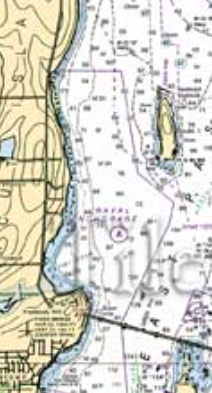
Day 1 featured an extended postponement on land, and I did a little spectating at a College NESA Conference regatta that was going on in the Harbor, hosted by Salve Regina University. The fact that there were 4 start lines in Newport in October (the others being Sonar Team Racing and Green Fleet) testifies to Newport's claim of being the Yachting Capitol. At 1:15pm PRO Todd Fedezyn sent us out for what would be one light air race. The wind had been light out of the south-east all morning and now it was light out of the South. The current had just been slack low and was starting to come in. Here is a picture of this tricky venue:

With the Southerly coming partly over the land and partly up the sound, there was the potential for a lot to happen. Tommy Sitzman had a good start and played it conservatively on the beat, but was passed by a couple boats that went hard left and found better pressure and apparently not-that-adverse current. Unfortunately his teammates did not really learn from this and failed to start at the pin the next two starts when, during the sequence, it became soo favored that the boats there port-tacked the fleet. Jack had a good comeback from a boat end start to 20th, while Lulu was so deep we almost called the Coast Guard! (JK) I think its important to analyze how we make decisions. I sympathize with Tommy playing the beat conservatively, although maybe he could have looked harder for where the pressure was. To not start at the favored end in unstable conditions is a big mistake and we paid the price!

The next day - no races!! We spent a day on the water with a couple starts and first beets by the blue fleet that had to be abandoned. The Wind shifted 100 degrees and back, and the race committee made a great effort, but at 3:30pm had to send us in. It's still a day on the water and we tested speed and the course numerous times, worked on sails, roll tacks, and socialized. On the tow in we tried to play the current by banging all the way in under Goat Island and passed Pili-we are always thinking tactics, current, going fast, and saving the sails on the towline. 

Day 3 would be the pivotal day of the regatta. With a solid overcast and a North-Easterly of 12-15kts we had high hopes for a day of racing. Although the wind dropped as low as 5kts PRO Fedezyn was able to get in 4 more races in each division. More tricky conditions from Newport - wind coming from a medium/distant shore and cross current flowing out. Overall, our sailors got dialed in with the current flowing from left to right and the pin being favored necessitating a play-the-left strategy. Going for what you see - playing the shifts and puffs is important, but realize that sailing into the current early keeps your options open and gets you closer to the mark. Freddie Parkin won the regatta by dominating the pin in his fleet. It wasn't that hard! The current was ripping away from the pin boat creating more space for 3 of the 4 races. Our sailors were more aware of the favored end of the line than on Saturday: Gill won the pin and flopped onto port tack in the biggest lefty of the day to win race 4. Lucy had a good boat start in the 1 boat start of the day and her patience & speed on the favored starboard tack netted a top 3. If not for the UFD Tommy would have won 3 of his last 4 races starting a couple boats from the pin and having great speed and height and playing the shifts on the left side of the course. 

We've sailed 2 regattas this year and the tactics of the last beat with the USODA course are really starting to sink in. The finish lines are being set to the "course right" of mark 2, which is intend to be set directly upwind of the leeward gate. Thus more port tack if there were no current. 


A quick note on directions - we say "left" and right" when looking upwind and cutting the course and half and discussing the first leg. On latter legs "course" means we are similarly orienting ourselves upwind. So the "course right "gate is also the "left turn gate" if if looking at it downwind. Think of it like Enders Game, just orient yourself to the goal, which is where the wind is coming from on the first and last legs. 

Here's how I see the beat skewing with left-to-right cross current. Essentially, you can make a better play by rounding the course left gate and not crossing the middle too soon. Just like what worked on the first beat, patience with the left! 


On one last beat Jack forced himself to the right of the competition and fell from 2nd to 3rd. Always know what you want and cover between the comp and the advantage! Or, if you are trying to pass, try to switch up the boats covering you and split to the advantaged puff/side. Any time I am coving the boats behind and splitting from the boats ahead toward what I think is more wind or the long tack, I am happy! 

But if the current is opposite, then play the "Golden Gate" and you don't have to cross under the downwind fleet at all:


As always, planning ahead and sailing relaxed are all keys to the last beat, as well as getting your settings (sprit tension, outhaul) back on from the downwind in a way that is smooth. We have a ways to go there and the best sailors will practice putting on and off their settings on even the smallest course! 

The results towards the end of the regatta were really nice as Tommy, Jack and Gill all won races, Lulu and Nico had a 2 and Lucy a 3, and Ben ended on a 7 to qualify for Team Trials. We hope that we can learn from our mistakes and sail well out of the box going forward, and feel better prepared for New Orleans for having sailed this regatta.  We now have 2-3 weeks of Team Racing to look forward to and are excited to keep working on situational sailing. Thanks to all the parents who made this trip possible, to Brad Reed  at Sail Newport and all the volunteers for hosting, to Emily and Grant who hosted the LYC Coaches in Newport, to my esteemed colleague and mentor Pilo Rocha, and to the sailors who, through their hard work give meaning to this amazing sport.