Wednesday, September 19, 2018

Regatta Debrief - 49th SE Dinghy Champs


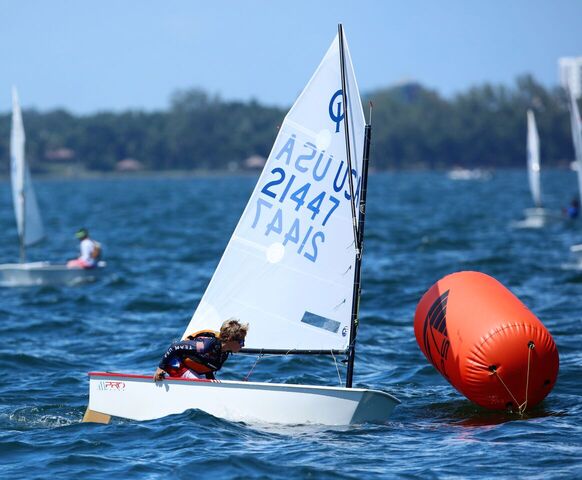
Saturday September 15th felt like Opening Day in any sport, with 97 Optis from South Florida and beyond racing again together on Biscayne Bay. Coaches, parents and kids from different yacht clubs were all happy to see each other again after summer travels and getting back to school. The race committee ran 4 great races in 5-10 knots of perfect seabreeze and sunshine. I was proud to have 31 sailors on the line representing LYC, and when Jack Redmond and Gill Hackel led the fleet into the first windward mark, felt a little jittery.

Gill Hackel took control of the event Saturday with 4 races of good starts, great upwind speed and good decision making, and on Sunday had his first major regatta win! I met Gill at the Lake Garda Optimist Meeting where we were with Team USA, and he began sailing with LYC this fall. Here's the scores of the top 10:

1

USA 21447
Gilman Hackel


LYC
1721149(27)
2

USA 16953
Freddie Parkin
Coral Reef/Riverside
281010323(14)
3

USA 21325
Cort Snyder
Coral Reef Yacht Club 
3159881(13)
4

USA 22280
Jack Redmond
LYC
33413(15)3121
5

USA 21419
Laura Hamilton
LYC 
43(29)5212510
6

USA 22278
Leopold Seuss
LYC
431224187(21)
7

USA 22291                  Nico Garcia- Castrillon
LYC
449412(25)136
8

USA 20482
Griggs Diemar
CRYC
46111(BFD-101)12220
9

USA 19458
Tyler Lamm
LYC
50(35)6710234
10

USA 20916
Owen Grainger
CRYC
55(26)22176
8


The depth of the fleet and the challenging conditions made it so not one sailor had all top 10 finishes! Cole Fanchi made the podium with a 3rd in White Fleet (under 11 age group) and Lulu Hamilton was top Girl (obvi)!


Having a first regatta this early in the season was great to have a benchmark (and regattas are often the best practice), but it was also early in terms of establishing routines and techniques, and there were a lot of mistakes! In the aforementioned first race, 1/3 of the fleet over-stood the Starboard layline to the first mark. Not recognizing the favored end of the line, underestimating the current, and even capsizing were all mistakes made by top sailors! Here are some notes for the sailors (and parents) I hope can clarify some things that happened.

Rigging/Sail Shape. 

Tommy Sitzmann trains in early 2018.
How do we judge an Opti sail? Is it how it hangs in the parking lot when the sailor asks "coach can you please check my sail?". We can check the basics there:

-Tight top corner tie & diagonal controlling the height of the sail.
-Basic/approximate luff tension with approximate vang and sprit ON.
-Is everything rigged correctly (knot in the outhaul, etc) and all "safety regulations" good?
-A little detective work on if the sailor rigged in the correct procedure (the sail doesn't lie!) .

But the actual judgement of the sail will come when it is fully powered on the first upwind leg of the race. At this point it will have the force of the wind on it - not just the true wind, but the added wind from the speed of the boat (called "Apparent wind"). It will have the full downward force of the mainsheet. The Wind-force + Mainsheet + Sprit forces will bend the mast, stretching the corner ties. At this moment, as the sailor is presenting the smoothest, most powerful-for-the-conditions sail shape, he or she will feel the force the sail pulls back on the mainsheet. He or she will have to judge not just the appearance, but the effect of the sail driving the boat through the water.

The sail cloth cannot lie about the forces begin put on it. If there is 1 big wrinkle coming off a sail-tie, then that sail tie is tighter than all the others and should be loosened! If there are wrinkles off all the sail ties, then the luff (front edge of the sail) tension is too loose. Less twists on the preventer and re-vanging solves that problem. Wrinkles across the sprit either way means the sprit needs adjusting! Sail too/high/low/wrinkles-that-even-more sprit tension won't solve point to the top corner ties.

If the sailor didn't even rig the sail in the first place, they will be completely lost when it comes to fixing/adjusting/tuning it on the water, and this is where the parent can do their kid the greatest disservice. There will be mistakes, heinous sail shapes, and tears when the sailor realizes half way through rigging that the boom-is-on-the-wrong-way and has to start over! But there isn't a great sailor out there that doesn't understand sail shape. That understanding comes from rigging and adjusting your own sails.

Correct rigging procedure for the sailor in the parking lot:
Above: throwback - Kevin Gosselin shows off his rigging process for OptiNews '17! Note: the sail has tension with no luff ties. 

1. Find cleanest, least traffic, shadiest spot, lay out sail, already tied to the boom.
2. Put mast through the preventer (aka Cunningham) loop. Make sure the sail us fully unrolled and boom right side up!
3. Rig the top corner ties. We show the sailors tricks on these in person in practice. These are the most important sail ties to get right!
4. Preventer on
5. Vang hand tight.
6. Sprit on until there are no wrinkles.

At this point the sail has shape and can be easily carried around. Many sailors prefer to put the sail up in the boat before the next step.

7. Rig luff ties. If the luff is not taught during this step, adjust the vang, preventer or sprit until it is tight. This is the secret to getting the luff ties even.


Current - Overview
We sail a lot on Biscayne Bay and feel like we understand the venue as well as any of the local clubs. See "Spring Fling Debrief" for explanations of the Tide & wind bends when the wind is coming form Key Biscayne. With Winds out of the South East for this regatta, we sailed mostly in "cross-current" - current pushing from at least 45 deg. off the wind angle.

"Fight it then ride it" is the adage for sailing in cross current, and this applies to the start line, beats and the run!

   - On the Start Line, the "up-current" end of the line will be lower risk - current is pushing boats away from that end, not piling them up. In races 1 and 2 that made it very easy to make the pin and the best start was to be had near there.
    It is very important to analyze if the current is pushing you over or under the line - tougher to asses in cross current but critical! We check the current with a gatorade bottle or orange tossed next to a starting mark. Then the sailor should practice both sailing down the line (are you being pushed up or down as you try to sail straight along it??)  and I also really like to do practice runs at the pin, so I know the layline and angles, and have a feel for the timing and acceleration.

  - On the first Beat (first upwind leg) sailing into the current generally puts you on the "long - tack" the tack you will spend a longer time on. So for races 1-2 with the current pushing from left to right, maintaining a lane on starboard tack was the key. Gill showed really good patience working the left edge of the leaders, always maintaining his up-current advantage until he could cross the fleet in a good position at the mark. By the same token, sailors that sailed down current (port tack) first got pinned to the right corner of the course and often overshot the layline. Extra distance and you are fighting the current to the mark as you watch the fleet cross in front of you!
     When the current switched (High Tide was 2:15 pm), all of a sudden the Left side became much more risky because it was down current! There was still a wind bend/current-bend  advantage I observed there, but you had to be in the top of the group and consolidate the fleet at the perfect time. With the starboard end of the line favored in race 4 (putting the starboard side of the fleet already ahead!) only Jack and Gill were able to escape and everyone else who started at the Pin end had a bad race. This shows the importance of recognizing the favored end of the line, and tying together you start and first beat strategy.

-On the run sailing the jibe that puts your bow towards the current makes you sail significantly less distance. I was happy that most of our sailors did not jybe in the races with current from boat to pin. You can plan/think ahead to your downwind strategy on the start line before the race, then re-check the angle of the current (look at the wake!) on Mark 2.

Wind 
Saturday the wind was a pretty normal Biscayne Bay seabreeze. Even with the direction South of the Key, the left was still the most consistent pressure, and even in the right-phase race there was a lefty before the windward mark.

Sunday there was more to unpack. We stress being the first team in the racing area (Gold fleet was both days) because everything you see means something. On the last day of J24 Nationals we were the first ones to the racecourse and saw a major positive stream in the current that was still there later, although it became less visible to the competitors that followed us out. We were able to sail in that stream to a huge first leg lead that helped us win the regatta by 1 point! The clue for SE Champs was a big shift almost to the NE (left shift) 20 minutes before the start. While the wind went back to a more regular Sea-Breeze direction for the race, this was an indicator that the wind would be fighting itself, and both the shifts and the differences in velocity were much bigger than on Saturday.

With big "Holes" - areas of low velocity (we Coaches will often call velocity "pressure" fyi - sorry physics majors!) on the race course it was important to:

 - Look for areas of "pressure" marked by darker, more rippled water.
- Be patient and sail into those areas of pressure.

Overall it was a tough first race for LYC as many sailors either started at the unfavored boat end, or tacked shy of the pressure.

In the next (and final) race, the wind shifted further right to the seabreeze, and many LYC sailors did recognize this and start at the now-favored boat end. With this sustained right shift, Nico Garcia-Castrillon, who sailed a consistently good regatta, got a little greedy and dug further right of the course, although he may have been winning already! Sure enough, even with the persistent right shift, it still came back to the left a little bit, allowing CRYC sailors Cort Snyder and Freddie Parkin to cruise back into the top 12, after starting at the wrong end but being patient with the left. Feeling pressure, Hackel was not as patient and posted more points than the rest of his regatta combined (his consistency up to that point gave him a throwout race to burn)! Jack Redmond sailed his best race of the event, starting right, consolidating, sailing conservatively and letting his boatspeed take over to end with a W, just like at last springs South Americans.


So my Biscayne Bay Takeaways (apply almost anywhere) :
  - Start at the pin if it is favored
 - Start at least boat half if the boat is favored
 - Consolidate the right almost immediately in a righty - it will not last.
 - Sail for pressure on the left, and be more patient on when to consolidate.
 - Always factor current into how you play the racecourse, and how you view risk on each side.
 -Always go for what you see over what you predict.

A note to the Bronze Fleet:
  If you don't understand these last few sections, don't worry about it! Technique is the most important thing by far to get down and thats where the focus should be. Only once you have speed and good start can you really apply everything else! There is a danger in overanalyzing or critiquing too much of a new RWB sailors tactic's. "Why'd my kid tack there?" leads them to stress decisions when they need to relax and develop tactics by instinct and by making mistakes they can learn from. The biggest gains will come from Technique, not tactics. 


Habits
Habits need to improve from this event going forward:
Issues:
 -Not all sailors rigged and ready on time
 -Borrowing my tape measure - bring your own! And always check the mast rake. Sailors can and do change the rake on the water based on feel or significant wind changes, but you should then measure and see what you changed it to! If it was fast, remember that setting. I measure the rake in inches with a range of 110" to 112" , depending on a lot of factors.
 -Slow launching. After a wind delay there is no excuse to be last off the dock! We are a team and reliant on our last sailor to launch before we can tow to the racecourse. Make sure you are all ready to go with plenty of time, and within the rules, endeavor to get your boat close to the launch point!
-Not testing the sail or start line between races. To have great boatspeed you have to work at it, testing the sail and the feel and balance of the boat; and checking the line and conditions is crucial.

LYC Coming to the Coach-boat Checklist: 

1. After finishing the race (and filing any protests or requests for redress with the RC finish boat or Measurement boat, as necessary) sail to coachboat.
2. Dock on leeward side, being careful of other teammates and control speed with sail luffing and using the rudder as a brake.
3. ASK for water, food from your bag, gatorade, chewy bars...or anything else you want. If you can reach it with feet in the Opti, get it yourself!
4. DEBRIEF the past race with your coach.
5. Discuss ADJUSTMENTS you want to make to your sailing, and any wind or current changes that may occur during the next race.
6. Put all trash back in your own bag (you are responsible for your bag+ trash)
7. Sail away for the coacboat, and begin to test your sail and analyze the racecourse for the next race!!

Once the coaches have had this interaction with each sailor, then we can begin to move about and help you look at your sails. As Pilo says "we are here to help you and to give you advices!" For multi-fleet regattas the later starts can watch the starts before them from the anchored coachboat, but should sail up until that warning signal, and regularly hop off to re-check their sails.


Mentality
   While fleet racing is an individual sport, we want to be a team that supports each other on and off the water. We want to be courteous with our competitors, and always thank the Race Committee and regatta volunteers. I was overjoyed to hear from another YC parent "I can always tell the Lauderdale kids by the way they act before I see what they are wearing - they are so polite." That was a really nice compliment and we have to work hard to maintain that standard!

We want to have the confidence in ourselves to embrace the challenge of winning, but also be ok with loosing too! Only when there is no fear of failure can you relax enough to sail your best. The lesson of how to think for one's self and make good decisions takes time and cultivating. I know each sailor on our team has strides to make this year and I am looking forward to the rest of the season!

LYC Opti sailors and coaches after awards at KBYC.
LYC representing in Red Fleet! From left: Leo, Lulu, Nico, and Jack. 


Thursday, July 26, 2018

LYC Wins Fleet & Team Opti Nationals


 From left: Jack Redmond, Lucy Meagher, Connor Boland and Sara Schumann soggily emerge from Pensacola Bay after Team Race Nationals. 


Stephan Baker got the party started in muggy Pensacola on July 18th when he closed out the U.S. Opti Fleet Race National Championship with a come from behind bullet in the final race. The four day event was contested by 256 sailors in Champ Fleet. With tricky current, different breezes and numerous weather related postponements it was a challenging regatta. The 23 foreign entries in the top 150 also added to the competition. Baker prevailed over Malthe Ebdrup of Denmark, who sailed a great regatta but was over the line - scored BFD on the final race - and put his name in the class's history as a 3 time National Champion (2 with LYC).

Here's a video the regatta made with Stephan and comments from Coach Pilo Rocha at the end!:

Other notable LYC finishers were Lulu Hamilton, Tommy Sitzman and Sara Schumann who finished 6th,7th and 8th overall - 4 LYC sailors in the top 10. Throughout the Gold Fleet LYC was represented by Cody Roe 16th, Lucas Tenrreiro 21st, Truman Rodgers 38th, KJ Hill 43rd, Nico Garcia-Castrillon 44th and Lauren Caron 80th. The regatta was a Team Trials Quallifier and 16 of the 18 sailors racing with the LYC program made the cut. Simone Moss represented LYC in perhaps the most important way, winning the Sportsmanship and Friendship Trophy after numerous nominations from her peers. 

 
       Simone and Coach Arthur

                               The LYC team with Coaches Arthur, Sharon and Pilo after the fleet racing awards. 


The Opti National Championship is a marathon, not a sprint - after 4 days of Fleet Racing, the ladies were sent out the next day for the "Girls Nationals," while the guys got in some team race practice. 3 Days of team racing loomed, making it an 8 day regatta + practice days! 

At the Girls Nationals, LYC's Sara Schumann narrowly missed a win to her LOOT (Lake Ontario Optimist Team) Summer Team teammate Samara Walsh. The result came after a late-night redress hearing that resulted in Race 3 being stricken from the record! (See results here).  Lulu Hamilton was 4th, Lucy Meagher 15th and Lauren Caron 16th. Friends of LYC (training partners in the last year) Annie Samies and Kaherine Doble placed 3rd and 5th overall! 


The Optimist Team Race Nationals is undoubtedly the biggest US hosted team race of the year. In addition to being a National Championship, only the winner traditionally qualifies to represent the US in the Opti Team Cup, Berlin (the Midwinters TR by comparison give 2 berths to the Marco Rizzotti Team Race). But the last 2 Nationals,  LYC's prior victories in Berlin have created an additional US berth, with LYC already quallified for the 2018 edition. So the pressure of qualification was off this year for the LYC 1 team and the sailors were sailing only for pride - trying to rebound from a tough Marco Rizzotti and secure a 3rd straight National Championship for the home club.
Optimist Team Racing is one of the most thrilling sports imaginable. 4 individual boats on 1 team against 4 individual boats on another. While Connor Boland described it succinctly as "I try to cover the boats on the other team to put my teammates ahead," it requires a full mix of sailing speed, tactics, strategy, teamwork and psychology to excel at. 

Connor and Lucy rip on the reaching leg. 

The team of Connor Boland, Lulu Hamilton, Lucy Meagher, Jack Redmond and Sara Schumann got off to a good start, winning 9 of 9 races on the first day. The fleet of 24 teams was split into 2 fleets of 12 by a ranking committee, and I think we may have had a tad easier initial grouping. We finished out the qualifying round perfect, with Southern Yacht Club Blue the only team to challenge us when we had 2 boats over the start line that had to go back. Lucy and Lulu waited until the first turning Mark to slow the race down and bring their teammates back into the mix, and they executed and team raced well.

LYC 1's Lulu Hamilton leads LYC 2's Kevin Gosselin in Gold Round action.  

 Then came the Gold round with the top 12 teams overall, and we continued to improve and remain undefeated. Each team member grew in their role. Against weaker opponents Connor had been finding 2 boats to luff up together, now against opponents with better fundamentals he was able to use his boathandeling and the space created by the RC Flag being on the bow of a large yacht, to get off the start line in a great position to control the race. Co-Captian Sara Schumann communicated a lot with Jack and Lulu while still being fast and making good decisions. It was windy - gusting 20kts, and Jack Redmond's work on speed payed off as he was always getting into the top 3 at the first mark. Lucy, as LYC 1's newest member brought a strong presence on the start line, stymieing Chicago's Peter Barnard in one start, and team racing effectively in wins against LISOT Black and Coral Reef YC's top team. Lulu brought speed, improved team race confidence, and great mental toughness and positivity that helped us though tough times on the last day! When it got to the Finals, there was very little coaching allowed and all the credit goes to my sailors! 

The biggest drama in the Gold round was a hearing following the CRYC race to determine if an opposing sailor's capsize on the finish line had (a) been LYC's foul (fault), and (b) had it allowed LYC to "gain an advantage" that effected the outcome of the race? I let you judge in these excellent photographs courtesy of Tom Barnard: 
Sara (21758) displays protest flag. 

CRYC boat that hit the pin Tacks.
...and Capsize! Sara's red flag still out...

 The protest was dismissed after an on-the-water hearing, and so at 22-0 we entered the knockout stage. We overmatched CERT and Worlds Team Sailor Thommie Grit in the semifinals 2-0, and then awaited the winner of the LISOT vs CRYC semifinal. In a heated series, LISOT prevailed 2-1 to secure qualifying for Germany. While this team was incorporating 2 new members, we had a lot of experience against them and knew that Samara Walshe, Griffin Gigliotti & Co. would be formidable opponents. 
       
We finally solved LISOT on the start line, pushing 3 boats over in the first race, but then disaster! In a complete meltdown LYC botched the 1,2,3,5 and rounded with LISOT winning in 2,3,4. A failed mark trap resulted in a Connor capsize! He asked for a 'professional foul' Black Flag, but in both this and the Gold round protest I agree with the Umpires that there was no "advantage gained." This is not summer learn to sail where sailors are grabbing each others masts and capsizing other boats! In both cases the team that capsized was already losing - so the self inflicted dip was not the reason they/we lost the race! 

Down 1-0 in the best of 5, we won the next race...but lost the 3rd. LISOT team raced really well on all 5 legs of the race, and as had happened at the Midwinters, we were in danger of letting the regatta slip away. The RC was giving the sailors no breaks between races, so the coach could only say 1 or 2 things, and the sailors were battling fatigue as well as the psychological pressure. I think this was where the LYC sailors athleticism really came into play - Sara and Lulu had been 'sailing themselves into shape', training and racing for 3 weeks straight with LOOT. Jack had been doing 1.5 hour distance sails in Newport, and Connor was a high schooler (he drove himself by car to day 2 of the Opti regatta, which I find hilarious) competing against kids - he could handle it. My only input was a couple tweaks on mark traps and coverages (coverage is easier if you "simo-tack" with your pair - tack to cover as they are tacking) and the knowledge that if we won race 4 all the pressure would shift back to the other team! LYC won a tight 4th race using the new play "12 Gap" that we had been evolving over the last couple regattas. Then in race 5 they again took the start, and out-sped LISOT into a 1,2,3,5 combo at mark 1. While Walshe pestered the 1,2,3 until the end of the race we were able to maintain the winning combination and took the regatta. 

The team jumped in the water to celebrate, but then it was back to life as usual - de-rigging and packing up our boats and hanging out with our friends from all over the Opti class. After the awards we (as a team) gave one of the most boring interviews ever to a television camera! While the total run is pretty crazy, winning the event is a goal you set each year, so achieving it really isn't that crazy or surprising - you always believed you had the power to do it. 


Team Race Nationals Historical prospectus:

The teams of the current LYC 3-peat:


2016 From Left: Connor Boland, Joey Meagher, Justin Callahan, Bella Cassaretto, Justin Callahan, Coach Arthur Blodgett
2017  From Left: Sara Schumann, Stephan Baker, Mitchell Callahan, Justin Callahan, Connor Boland, Coach Arthur Blodgett 

2018 From Left: Lucy Meagher, Connor Boland, Sara Schumann, Lulu Hamilton (not pictured: Jack Redmond, who had to catch a flight and missed the party, and coach Arthur). 


The longest winning streak in TR Nationals history belongs to Coconut Grove Sailing Club, which won 5 straight from 1979 to 1983, twice with a kid named Bobby Meagher. 

Here's the winningest clubs since the Trophy's 1977 Inception, along with years won:

St. Petersburg Yacht Club (9): '78, '84, '85, '86, '87, '89, '91, '96, '97. 

Coconut Grove Sailing Club (8): '77, '79, '80, '81, '82, '83, '88

Lauderdale Yacht Club (5): '10,'11,'16, '17, '18

Southern Yacht Club (5): '95, '99, '00, '01, '02

LISOT (5): '03, '06, '07, '13, '15

Team FOR (3): '04, '05, '12


Coral Reef Yacht Club (1): '90

Friday, July 6, 2018

Quotes and Calls for Summer Reading

Hopefully you have been able to follow our sailor's recent successes at Team Trials and international events on our social media and other publications. Its been an awesome year! As we prepare for Nationals and then many take a month off from competition (maybe you will have time for some reading?), I wanted to share some quotes from a book I'm enjoying that relate to sailing...and also some calls from "The Call Book for Team Racing" - ISAF official interpretations of common rules situations, in picture form!

The book: Deep Thinking: Where Artificial Intelligence Ends...and Human Creativity Begins, by Garry Kasparov. Kasparov was the World Chess Champion from 1985 to 2000 and the first World champ to lose a chess match to a computer - IBM's Deep Blue in 1997. 


"I speak regularly about the difference between strategy and tactics, and why its essential to first understand your long term goals so you don't confuse them with reactions, opportunities or mere milestones. Adapting to circumstances is important, but if you change your strategy all the time you don't really have one." 


"To become good at anything you need to know how to apply basic principles. To become great at it, you have to know when to violate those principles."


"Its unavoidable that results will get most of the attention, but its important to look beyond wins and losses. The moves matter more than the results." 


"Focusing on material is how novice humans play, especially kids. They care only about gobbling up their opponents pieces and ignore other factors in the position, such as piece activity and whose king is safer. Eventually they learn from experience that while materiel is important, it doesn't matter how many of your opponent's pieces you've captured if your king is getting checkmated.

Early chess machines couldn't learn from the experience the way people can. Those greedy kids are learning each time they get checkmated. "


"Every competitive person has to have a sizable ego, so losses can hit particularly hard... There must be a critical balance between putting a bad loss put of your mind so you can go into your next game full off the confidence, [and being able to] objectively analyze your failures so you do not repeat them."


"...motivation matters very much. The ability to maintain an intense level of concentration for an extended period of time is significant..." 


"Lastly, don't tell me that hard work can be more important than talent...hard work is a talent. The ability to push yourself, to keep working, practicing, studying more than others is itself a talent. If anyone could do it, everyone would. As with any talent, it must be cultivated to blossom." 


Ok, on to the Call Book for Team Racing highlights! My comments in blue.


A windward leeward situation, with the umpires having to decide if the right of way boat changed course too much/too fast. In every rules situation the umpires will have to consider if the Right of Way boat breaks rule 16. 

Also, when reading the Call Book, pay special attention to the italicized text (not there after every call)! 


So What can a Right of Way boat do to inoculate herself from potentially fouling?? Avoid contact! If they kept clear then there was 'room to keep clear.'  

We make this lesson a key tenet of our team race system: "Control without fouling." 

I like to apply this call to jibing on the downwind leg. Jybe to starboard with a port boat abeam of you, but then head away by-the-lee to give them plenty of room to keep clear. Then when they do jibe to starboard, you can head them up! 


'Last point of certainty' is a key concept. Try to talk the umpire through your last point of certainty, especially with overlaps. Example: If they hear you yell “I'm clear ahead" at 5 boatlengths, and again at 3 and 2, they will be more likely to agree that you have mark room and understand you might be about to set a mark trap. 


'Advantage Gained after Breaking a Rule' used to be called a "professional foul." 


An aggressive, legal move every top team racer has in her arsenal. Usually the contact that occurs is rig contact, as the tacking boat rolls her rig into the ducking/shooting opponenas in this LYClassic Patrick Rynn video. (featuring Jensen McTighe and Max Gillette) 

Note that Y does not alter course from position 2 to position 4 as you consider the next call. 


So whats the difference between E3 and D4? When the "hunting up" boat changes her course. In D4 it is pre-tack, in E3 it is mid-tack. Thus, you cannot hunt a boat once she is across head to wind and into her tack. 

Note the "no part of rule 18 (Mark Room) applies." So for 18 to apply, both boats have to be on the same tack. 


These are just the rest of the common windward mark calls (because one of my students asked). To me the general practical application is:

1. If you get to mark 1 with an opponent clear behind but close, just try to make a clean rounding with a good roll tack around/above the mark. 

2. If you are trying to set a mark 1 trap, make your opponent go outside of you before rounding. 

3...but if someone else completes a tack inside of you while your luffing, they now have "Mark Room." 

4. So "The Mark 1 Trap is the friend of the team that is currently loosing!" 


Shoutout to match race ace Adrienne Patterson who taught me that the Mark 2 traps are really where its at in Optis...

This was the last more Mark Trap call I swear! The Mark Trap ends (Rule 18 turns off) when the boats are abeam of the mark pointed on the next leg. 

You can't close the door too late! 


LYC 1 Team Race Rule: If you are luffed by an opponent and our team is winning, Tack away immediately. Don't sit and wait/foul! Your friends can slow down the opponent a little before you have to make your next cross - keep sailing fast. 


                       Arthur Blodgett has been the head Opti Coach at LYC since 2014. You can reach him  at arthur.blodgett@lyc.org

Wednesday, April 18, 2018

Spring Fling - Regatta Debrief


38 LYC sailors invaded Miami this past weekend for the Spring Fling Regatta hosted by Coral Reef Yacht Club.  Stephan Baker continued his winning ways posting Bullets in all 6 races. Connor Bolland was 2nd overall, sailing his best event to date with only 1 finish outside of the top 3. Other top LYC finishers were Sara Shcuman (5th) Tommy Sitzman (7th), Cody Roe (9th), Jake Homberger (11th), Jack Redmond (13th), Lulu Hamilton (20th), Ty Lamm (23rd), Ryan Konrad (24th), Nico Garcia-Castrillon (28th), Lucy Meagher (34th) and Lucas Tenrierro (36th) - so 13 LYC Sailors in the top 40, with 130 boats in attendance. 12 LYC Green Fleeters also competed led by Pierce Webber in 12th. Full Results. 

We are almost to the USODA Team Trials, the biggest event of the year, and this was the last "Test Event" before the regatta. As Trials, the venue was Biscayne Bay,  and I think the level of competition was pretty good - all the best Florida and east coast Opti sailors as well as some Texans, Californians and Illinoisans were in attendance. So while sailors should expect the overall competition to  go up a level at Team Trails, it was a true "test even" in both the venue and competition.

It is my hope that this recap of the conditions and corresponding racing priorities can help sailors to synthesize their last weekend. The conditions may be different going forward or they may be the same! We want to be fast, and have a grasp of all the conditions on Biscayne Bay.


Saturday Wind:

Saturday brought breeze from the SE - 120-140 Degrees on the Compass at first start. When the wind comes from this direction over the Key, we have learned that it creates a bend. This bend manifests as a geographic shift to the left as you reach the top of the racing area. Like this:


The sailors tested the course before Race 1 and almost all split tacks came back Left favored. So we figured the theory applied. The sky was clear and sunny, so the first race was all about execution to the left - where-ever you start its all about getting and holding a lane on Starboard Tack. With the pin significantly favored for this start this was difficult! There were some black flag disqualifications and a lot of boats fighting for the Pin 3rd of a short start line.

Before the 2nd race the wind shifted right to about 155 deg. and the boat was slightly favored. There were now a lot of Black Flag penalties (always more BFD on a boat favored line). As low, puffy seabreeze clouds began to appear I cautioned sailors to be aware that a further shift right could occur. CRYC's Cort Snyder seemed to have the same philosophy and sailed hard to the right corner. However, as I watched the race from the right corner, I could feel the puffs coming...and going. There was not the sustained pressure to get across from the right. The LYC sailors that trusted their eyes the most - looking up the course and seeing better pressure on the left - made out ahead! This is an important lesson: the forecast and coaches can tell you what might happen - but trust your eyes the most on what is actually occurring that moment! The wind on the water (marked by darker water or choppier waves) is telling you what IS happening.

The Wind did shift Right - to as much as 170 degrees, and on the last beat Cody and KJ made up a ton of ground by being patient with the right.

The wind oscillated back and forth at about 165 degrees for the rest of the day. With light air and consistent conditions, sailing the "Golden Route" becomes really important. It looks like this:


Popularized by Joakim Karlson, the Golden Route is essentially the strategy that you should get out to start the race to what you think is the favored side  then move in (aka "CONSOLIDATE!") further up the beat as you side begins to pay off. You get clear air and hopefully better pressure/current to get ahead, then consolidate on the best wind shift/angle you can once you are ahead.

Boats that sailed up the middle to start the beat and weren't winning ate too much dirty air and had no chance in these 6-8kt, choppy conditions.

If you picked the wrong side, you could still make it work, with:
  -BOATSPEED
 - PATIENCE
 - Lead your side back, consolidating at the 'least bad' time.

Connor Bolland did this beautifully in the 3rd race. He was on the right trailing Cort and KJ who had gotten out to clear air first. But he led them back to the middle and continued to play the wind shifts and sail in clear air all the way to the windward mark - rounding Mark 1 in the top 5 and able to get a 2nd. For my Silver fleet sailors they are still perfecting the Golden route - KJ moved out great and had awesome speed, but didn't always know when to consolidate. Cody, Kevin and Will started the beat eating up too much of the middle. Nico on the other hand seemed to have really good lanes when I saw him at the top of the beat. Truman's starting wasn't up to the level he's displayed in practice, although he had a good consistent regatta (this will pay on a 4 day event). Tyler was super fast and I think close to some even better races. Cody had a breakout regatta not on the first beat, but in working hard and focusing around the racecourse, passing a ton of boats on the reach, run and last beat. I'd estimate he gained 30 points after the 1st mark over the course of the first 4 races!
Spring Fling 2018 - Day 1 (rated)47.JPG
Photo: Tom Rodgers 

Current:

The current is opposite of what you think should happen. It flows in (low tide to high tide) to Biscayne bay FROM the North, and Flows out TO the North. The 2 Bridges, the Bear Cut Bridge and the City Bridge are essentially the veins of Biscane Bay - the tide comes in and goes out through them.

The Tide forecast was for High Tide just before racing and an ebbing current all day. Current goes faster in deeper water, but changes first in shallow water. Thus the current angle in our racing area shifted throughout the day -early on it was flowing towards the shallower City Bridge, later towards max ebb it was going more towards the Bear Cut Bridge:


The Current was less than we expected, but still effected the racing on Saturday with light wind. The current is not always as predictable as you would think on the Bay, so its important to always be re-checking it between races and even during each race (see which way are you sliding while rounding each mark?). Keep an open mind on when it might increase, decrease, or shift in vector!

As the current increases towards the Bear Cut with wind from the SE, one must be careful not to be swept over the Port Layline/get pinned out on the port side. With current less than usual this didn't happen too much, but something sailors should be aware of. As we learned in Lake Garda, the favored side doesn't pay if you go over the Layline!

Sunday Conditions:

Sunday was breezier and overcast, with threatening advisories from some news sources! But really he wind was only about 15-18 kts. Not too much! We sailed 2 races in each fleet and flew in on a broad reach. With small shifts and almost slack current it was all about getting off the line, and goin' real fast! The wind-blown current was enough that there was some line sag, so that you could really start ahead of the competition. This is what a line sight is made for in Optis - you will not be able to use a line sight when boats are over, but when the fleet is under the line it will give you the confidence to punch out!

The line was square and there was just Ocean to windward, but the left paid for some reason on most  beats. I don't know exactly why this was. The wind was only 180 degrees - just south of the end of the key, so its possible there was some Key-induced acceloration of the breeze on the left. Stephan, who understands more than most of the coaches, covered Connor almost all the way to the layline on the Left, not being concerned with the boats on the right in first beat of the last race, and they rounded 1,2. It will be interesting to see if the Trend persists with a different Tide while sailing in a breezy Southerly.

Speedwork:

Speed comes from 2 things: Tuning and Technique. Our kids Tuning has gotten pretty good but we are always looking for perfection in our sails. Making sure the boom-vang and the luff are actually  tight before rigging the Luff ties can help some sailors get the luff ties more even.

There will be a Measurement boat at TT's so boom ties - you matter to us now! Same for the Daggerboard Tie in (a safety regulation).

There were no Judges for Rule 42 at Spring Fling. I though our sailors were sailing within the rules (Pilo and I will asses penalties for breaches in practice), but we should be prepared for a little more scrutiny at Team Trials. I hope the judges will pay special attention to Upwind Sculling in light winds - its something we work hard to prohibit our sailors from, but that I observe from some other competitors.

Downwind our sailors had pretty good speed just by being forwards in the boat, limiting rudder movement, and focusing on the waves.

Balancing the boat upwind on Biscayne Bay often means moving back a little of your normal position (back 2cm?). This helps the boat get through the Chop without the bow pounding. Upwind the bow drag is a bigger concern than the stern dragging a little.

The Chop don't lie! If you are connected to the boat, have good technique and focus on every wave, you will be fast. Every wave you hit wrong slows you down a lot. Its possible that Stephan might be only 5% better than the next sailors in the Country, but its those few more waves they hit wrong that slow them down considerably and take boatlenghts to recover from. You need to sail relaxed so you can work the boat consistently and think at the same time!

One thing sailors should always be aware of is large powerboat wake. Parents and coaches are running up and down boat the Right Edge of the first beat and the Left Edge of the Last beat. So as you reach the corner you have a decision: to go thought the waves, or tack and try to surf them as you consolidate. If you get the pressure or a header just before some boat chop, or the chop will stop you if you don't tack- Tack with speed before the waves then try to surf them upwind!!!

Checking habitually for SeaWeed on the foils is a key skill we have been practicing and may have contributed to our sailors good speed Saturday.

Food/Hydration/Coaching:
Sailors were given very little time between each race and need to do a better job eating and drinking water! Make sure your food is accessible and your bag CLEARLY LABLED! First, last and Sail # should all be marked on it. Ask for Water and food first, then advice! Then go test your sail and the course/start line, and come check in with the coach again. Is a working relationship where we are here to help you and give you advice. We're not here to spoon feed you and tell you what to do - you have to analyze and think for yourself! Of all the coaches I think I anchored the least, preferring to be free to check the current, check the line and wind with my compass, and make a quick comment to a sailor on the edge of the waiting area. The downside to this is if we have to fix something I drift downwind. If your coach is drifting too far downwind - don't sail down to them. Gather as much information as you can and check in when they motor back up to the top of the waiting area! Our coaching team for this regatta in addition to myself was Pilar Calabresse and Pilo Rocha - two awesome colleagues!

Mental Prep for Team Trials:
We were the most prepared team at Spring Fling. We practiced with KBYC the previous weekend, and were one of the few teams out to practice at the venue Friday. With 4 more practices scheduled at KBYC before team trails we hope to maintain this edge! Here's some things to think about:

* On a 4 day regatta, consistency is key. 

*The top boats should be working togehter to extend on the fleet up until the last leg- "Keep your 4th!" as we say in College Sailing - Arthur 

*"The regatta is always from here on out - take it ONE race at a time!" -Arthur 

*"Its all about sailing relaxed" -Pilo 

*"Pressure is just you minds way of reminding you to do a good job."  - Arthur 

*"Fill your mind with what matters - sailing fast and looking around." - Michael Blackburn

*"The best sailors have already won the regatta before it even begins." - Paul Elvestrom 

* "Its all about your Attitude!"  - Pilo

*Visualize yourself sailing well" - Blackburn

*Garret, if you do not make good race I will [dump you in the water]!"- Pili, 2015 Trials  
(Just kidding!) 


Thank you to everyone (all the parents) who have been supporting us through a great season, and we hope to make it a successful Team Trials next week!


Spring Fling 2018 - Day 1 (rated)61.JPG
Photo: Tom Rodgers