Wednesday, April 18, 2018

Spring Fling - Regatta Debrief


38 LYC sailors invaded Miami this past weekend for the Spring Fling Regatta hosted by Coral Reef Yacht Club.  Stephan Baker continued his winning ways posting Bullets in all 6 races. Connor Bolland was 2nd overall, sailing his best event to date with only 1 finish outside of the top 3. Other top LYC finishers were Sara Shcuman (5th) Tommy Sitzman (7th), Cody Roe (9th), Jake Homberger (11th), Jack Redmond (13th), Lulu Hamilton (20th), Ty Lamm (23rd), Ryan Konrad (24th), Nico Garcia-Castrillon (28th), Lucy Meagher (34th) and Lucas Tenrierro (36th) - so 13 LYC Sailors in the top 40, with 130 boats in attendance. 12 LYC Green Fleeters also competed led by Pierce Webber in 12th. Full Results. 

We are almost to the USODA Team Trials, the biggest event of the year, and this was the last "Test Event" before the regatta. As Trials, the venue was Biscayne Bay,  and I think the level of competition was pretty good - all the best Florida and east coast Opti sailors as well as some Texans, Californians and Illinoisans were in attendance. So while sailors should expect the overall competition to  go up a level at Team Trails, it was a true "test even" in both the venue and competition.

It is my hope that this recap of the conditions and corresponding racing priorities can help sailors to synthesize their last weekend. The conditions may be different going forward or they may be the same! We want to be fast, and have a grasp of all the conditions on Biscayne Bay.


Saturday Wind:

Saturday brought breeze from the SE - 120-140 Degrees on the Compass at first start. When the wind comes from this direction over the Key, we have learned that it creates a bend. This bend manifests as a geographic shift to the left as you reach the top of the racing area. Like this:


The sailors tested the course before Race 1 and almost all split tacks came back Left favored. So we figured the theory applied. The sky was clear and sunny, so the first race was all about execution to the left - where-ever you start its all about getting and holding a lane on Starboard Tack. With the pin significantly favored for this start this was difficult! There were some black flag disqualifications and a lot of boats fighting for the Pin 3rd of a short start line.

Before the 2nd race the wind shifted right to about 155 deg. and the boat was slightly favored. There were now a lot of Black Flag penalties (always more BFD on a boat favored line). As low, puffy seabreeze clouds began to appear I cautioned sailors to be aware that a further shift right could occur. CRYC's Cort Snyder seemed to have the same philosophy and sailed hard to the right corner. However, as I watched the race from the right corner, I could feel the puffs coming...and going. There was not the sustained pressure to get across from the right. The LYC sailors that trusted their eyes the most - looking up the course and seeing better pressure on the left - made out ahead! This is an important lesson: the forecast and coaches can tell you what might happen - but trust your eyes the most on what is actually occurring that moment! The wind on the water (marked by darker water or choppier waves) is telling you what IS happening.

The Wind did shift Right - to as much as 170 degrees, and on the last beat Cody and KJ made up a ton of ground by being patient with the right.

The wind oscillated back and forth at about 165 degrees for the rest of the day. With light air and consistent conditions, sailing the "Golden Route" becomes really important. It looks like this:


Popularized by Joakim Karlson, the Golden Route is essentially the strategy that you should get out to start the race to what you think is the favored side  then move in (aka "CONSOLIDATE!") further up the beat as you side begins to pay off. You get clear air and hopefully better pressure/current to get ahead, then consolidate on the best wind shift/angle you can once you are ahead.

Boats that sailed up the middle to start the beat and weren't winning ate too much dirty air and had no chance in these 6-8kt, choppy conditions.

If you picked the wrong side, you could still make it work, with:
  -BOATSPEED
 - PATIENCE
 - Lead your side back, consolidating at the 'least bad' time.

Connor Bolland did this beautifully in the 3rd race. He was on the right trailing Cort and KJ who had gotten out to clear air first. But he led them back to the middle and continued to play the wind shifts and sail in clear air all the way to the windward mark - rounding Mark 1 in the top 5 and able to get a 2nd. For my Silver fleet sailors they are still perfecting the Golden route - KJ moved out great and had awesome speed, but didn't always know when to consolidate. Cody, Kevin and Will started the beat eating up too much of the middle. Nico on the other hand seemed to have really good lanes when I saw him at the top of the beat. Truman's starting wasn't up to the level he's displayed in practice, although he had a good consistent regatta (this will pay on a 4 day event). Tyler was super fast and I think close to some even better races. Cody had a breakout regatta not on the first beat, but in working hard and focusing around the racecourse, passing a ton of boats on the reach, run and last beat. I'd estimate he gained 30 points after the 1st mark over the course of the first 4 races!
Spring Fling 2018 - Day 1 (rated)47.JPG
Photo: Tom Rodgers 

Current:

The current is opposite of what you think should happen. It flows in (low tide to high tide) to Biscayne bay FROM the North, and Flows out TO the North. The 2 Bridges, the Bear Cut Bridge and the City Bridge are essentially the veins of Biscane Bay - the tide comes in and goes out through them.

The Tide forecast was for High Tide just before racing and an ebbing current all day. Current goes faster in deeper water, but changes first in shallow water. Thus the current angle in our racing area shifted throughout the day -early on it was flowing towards the shallower City Bridge, later towards max ebb it was going more towards the Bear Cut Bridge:


The Current was less than we expected, but still effected the racing on Saturday with light wind. The current is not always as predictable as you would think on the Bay, so its important to always be re-checking it between races and even during each race (see which way are you sliding while rounding each mark?). Keep an open mind on when it might increase, decrease, or shift in vector!

As the current increases towards the Bear Cut with wind from the SE, one must be careful not to be swept over the Port Layline/get pinned out on the port side. With current less than usual this didn't happen too much, but something sailors should be aware of. As we learned in Lake Garda, the favored side doesn't pay if you go over the Layline!

Sunday Conditions:

Sunday was breezier and overcast, with threatening advisories from some news sources! But really he wind was only about 15-18 kts. Not too much! We sailed 2 races in each fleet and flew in on a broad reach. With small shifts and almost slack current it was all about getting off the line, and goin' real fast! The wind-blown current was enough that there was some line sag, so that you could really start ahead of the competition. This is what a line sight is made for in Optis - you will not be able to use a line sight when boats are over, but when the fleet is under the line it will give you the confidence to punch out!

The line was square and there was just Ocean to windward, but the left paid for some reason on most  beats. I don't know exactly why this was. The wind was only 180 degrees - just south of the end of the key, so its possible there was some Key-induced acceloration of the breeze on the left. Stephan, who understands more than most of the coaches, covered Connor almost all the way to the layline on the Left, not being concerned with the boats on the right in first beat of the last race, and they rounded 1,2. It will be interesting to see if the Trend persists with a different Tide while sailing in a breezy Southerly.

Speedwork:

Speed comes from 2 things: Tuning and Technique. Our kids Tuning has gotten pretty good but we are always looking for perfection in our sails. Making sure the boom-vang and the luff are actually  tight before rigging the Luff ties can help some sailors get the luff ties more even.

There will be a Measurement boat at TT's so boom ties - you matter to us now! Same for the Daggerboard Tie in (a safety regulation).

There were no Judges for Rule 42 at Spring Fling. I though our sailors were sailing within the rules (Pilo and I will asses penalties for breaches in practice), but we should be prepared for a little more scrutiny at Team Trials. I hope the judges will pay special attention to Upwind Sculling in light winds - its something we work hard to prohibit our sailors from, but that I observe from some other competitors.

Downwind our sailors had pretty good speed just by being forwards in the boat, limiting rudder movement, and focusing on the waves.

Balancing the boat upwind on Biscayne Bay often means moving back a little of your normal position (back 2cm?). This helps the boat get through the Chop without the bow pounding. Upwind the bow drag is a bigger concern than the stern dragging a little.

The Chop don't lie! If you are connected to the boat, have good technique and focus on every wave, you will be fast. Every wave you hit wrong slows you down a lot. Its possible that Stephan might be only 5% better than the next sailors in the Country, but its those few more waves they hit wrong that slow them down considerably and take boatlenghts to recover from. You need to sail relaxed so you can work the boat consistently and think at the same time!

One thing sailors should always be aware of is large powerboat wake. Parents and coaches are running up and down boat the Right Edge of the first beat and the Left Edge of the Last beat. So as you reach the corner you have a decision: to go thought the waves, or tack and try to surf them as you consolidate. If you get the pressure or a header just before some boat chop, or the chop will stop you if you don't tack- Tack with speed before the waves then try to surf them upwind!!!

Checking habitually for SeaWeed on the foils is a key skill we have been practicing and may have contributed to our sailors good speed Saturday.

Food/Hydration/Coaching:
Sailors were given very little time between each race and need to do a better job eating and drinking water! Make sure your food is accessible and your bag CLEARLY LABLED! First, last and Sail # should all be marked on it. Ask for Water and food first, then advice! Then go test your sail and the course/start line, and come check in with the coach again. Is a working relationship where we are here to help you and give you advice. We're not here to spoon feed you and tell you what to do - you have to analyze and think for yourself! Of all the coaches I think I anchored the least, preferring to be free to check the current, check the line and wind with my compass, and make a quick comment to a sailor on the edge of the waiting area. The downside to this is if we have to fix something I drift downwind. If your coach is drifting too far downwind - don't sail down to them. Gather as much information as you can and check in when they motor back up to the top of the waiting area! Our coaching team for this regatta in addition to myself was Pilar Calabresse and Pilo Rocha - two awesome colleagues!

Mental Prep for Team Trials:
We were the most prepared team at Spring Fling. We practiced with KBYC the previous weekend, and were one of the few teams out to practice at the venue Friday. With 4 more practices scheduled at KBYC before team trails we hope to maintain this edge! Here's some things to think about:

* On a 4 day regatta, consistency is key. 

*The top boats should be working togehter to extend on the fleet up until the last leg- "Keep your 4th!" as we say in College Sailing - Arthur 

*"The regatta is always from here on out - take it ONE race at a time!" -Arthur 

*"Its all about sailing relaxed" -Pilo 

*"Pressure is just you minds way of reminding you to do a good job."  - Arthur 

*"Fill your mind with what matters - sailing fast and looking around." - Michael Blackburn

*"The best sailors have already won the regatta before it even begins." - Paul Elvestrom 

* "Its all about your Attitude!"  - Pilo

*Visualize yourself sailing well" - Blackburn

*Garret, if you do not make good race I will [dump you in the water]!"- Pili, 2015 Trials  
(Just kidding!) 


Thank you to everyone (all the parents) who have been supporting us through a great season, and we hope to make it a successful Team Trials next week!


Spring Fling 2018 - Day 1 (rated)61.JPG
Photo: Tom Rodgers      

Friday, April 6, 2018

36th Lake Garda Optimist Meeting - Regatta Debrief


Its hard to conceptualize what 1,000 Optis look like. I can give you numbers, like 4 times the size of Team Trials, but until you are in the thick of a waiting area ensconced in luffing sails, different languages on each coachboat, it will not register. Add rain, low 40 degree temperatures and variable conditions, and you have the 36th Lake Garda Optimist meeting, which also set a record as the largest one design regatta of all time.

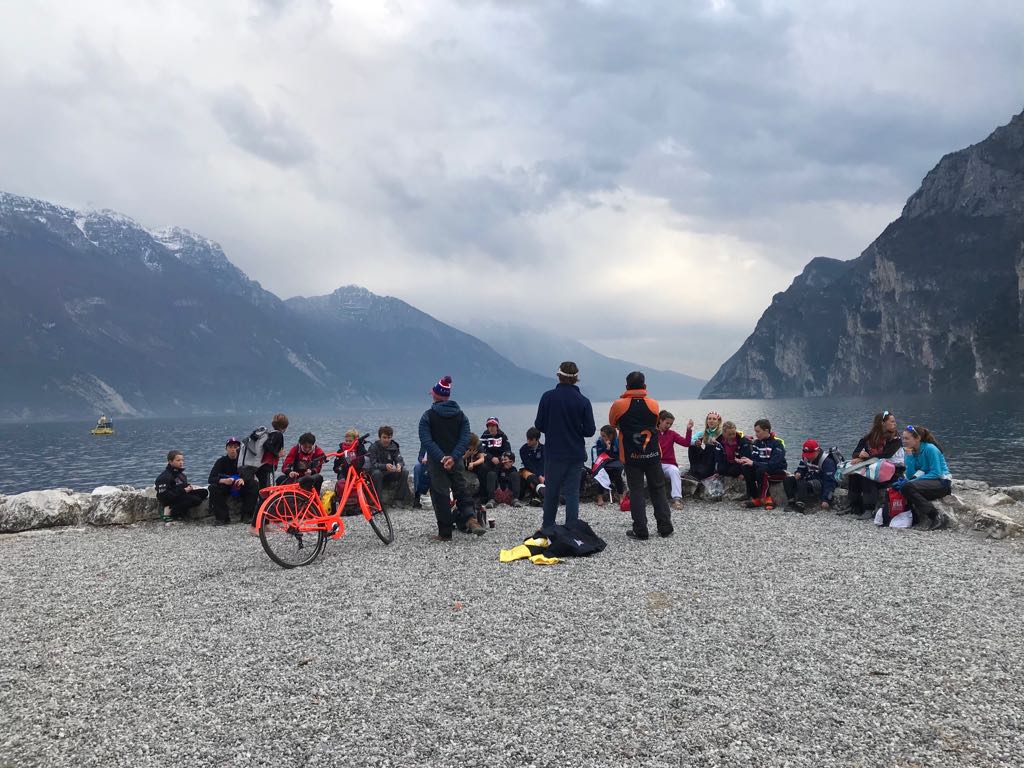
I was there with 20 sailors representing team USA, and working alongside top coaches Justine O'Connor and Juan Carlos Romero. Juan and I flew out of Miami and arrived in Milan the morning before we would meet with the Team. Our van driver Luca collected the Walshes (Jane and Samara) and we headed east for Lake Garda. The car ride itself was instructive on the Geography. Because of the mountains, you approach the Lake from the Southern end. Here the land is flat, and the lake at its widest. Drive North 10 miles and boom -- you are in the southern Alps! We wound through tunnels carved into the mountain-side, as the cliffs shoot up from the Lake at at least a 75 degree slope. The mountain peaks across the lake had snow on them, and looking up to the lake to the North was the endless Alps. It's important to always do due diligence on a venue before sailing there -- I had looked at toppo maps and read about the wind patterns. This helped to know what was North/South etc, where we would be sailing, and to place the features. However, the scale of things in Garda is still pretty breathtaking! The small town of Riva Del Garda sits at the top Northern end of the lake. We arrived, checked in, found Justine and met with 12 of the sailors to get their charters Optis.
Riva del Garda from the Air

Expected Conditions:
Most RWB Opti Sailors are familiar with the phenomenon we call the "Seabreeze," the daily geothermal effect that brings wind from off-shore along coastlines all over the world. The land heats air (and creates low puffy clouds) that then expands out over the water. When the ocean then cools that same air, the Sea Breeze completes the cycle! Garda has its own geo-thermal phenomenon, but it behaves more like a cylinder than a cycle. At night the cold air from the mountains flows down and out to the south. As the southern plains heat up, that air expands, and shoots up the lake - all at once with 12-35kt Velocity, depending on the temperature differential.


So the warmer it is in the morning, particularly 20-60 miles south of the venue, the more wind there will be by 1pm. Overcast, especially cold days, and rain (as we would see in the regatta) can kill this lake breeze. With the regatta 3 weeks earlier than the previous year (and thus cooler spring time temps) we expected it to be a little lighter, but still over 15kts on sunny days.

"The right always wins" was the report of everyone who had sailed or coached Optis here. The reason: the course had always set to the right third of the lake looking to the south, which has particularly steep cliffs. The wind not only funnels along the cliffs, but the air flows faster because it has to travel more distance around the curvature of the shoreline. So everyone was expecting a drag race into the right corner to get this shoreline benefit. On the practice days we would test this with the sailors extensively.
Team USA ready for practice. 


Equipment:
"There's no problem we can't solve" said Justine to the team the first night. Identifying problems with your charter boat takes time, patience, and an eye for detail. The sailors were given as much time as they needed the first night and the next morning before launching, with coaches to assist in personalizing their boats and making them perfect. Nevertheless it took several more days to get everything dialed in!

Here's a list of everything you should expect to do to a charter boat (and on your boat too!):

- Check mast collar bolts for tightness/tighten a little (these boats were good, the Winner Optis I find need a couple twists with a hex wrench and vice grips)

-Check mast cup & bowline knots.

-Make sure the inflation stems on the front airbags are in the back (deflate and turn airbags around if necessary) so you can blow them up on the water without swamping.

-Hiking straps - are they the right length with a good/adjustable knot? I had a number of kids hike out on land to make sure they could get out enough (knees over the rail!) and the rail was at a good angle on their legs. Smaller sailors need looser straps to hike harder; bigger sailors need tighter straps so they stay connected to the boat.

-Boom bridle - ring in the right place? I like the ring directly over the back edge of the Daggerboard trunk, so that sailors can cross 'rail-to-rail' without having to move back. It doesn't matter if the sailor is big or small -- most small sailors have 4:1 mainsheets anyway to make trimming easier, and a little sailor should learn to tack correctly from the start!

-Boom Bridle tight? I do a double trucker hitch as you get more purchase and the knots come out easier if you have to re-adjust. 1/8" vectran is the line to use and replace every season! This is the one piece of rigging a coach or parent can do for the kid - everything else they should do! A tight bridle is essential for safety and fast tacks!

-Mast rake - where you like it based on your weight and the wind and wave conditions. I like a range of 110-112 inches. Best to measure with no sail on the mast for starters! Sailors should use a tape measure to get it about right, but then be willing to change on the water based on feel on the helm and if the boat is fast or not. Then measure again and record in your notes if you found a particularly fast mast rake. Juan Carlos stresses that sailors should rake slightly forward in more wind. This is because he mast bends more, so you are basically sailing at the same rake! If you rake back in breeze (as parents used to sailing sloops will be accustomed to) you overload on weather helm and the boat gets stuck in irons. If you are cracking (easing) the sprit to de-power, definitely rake forward of usual.

-Daggerboard Bungee tight? You will have to check this on the water. We chartered NewBlue Optis - good boats, but all the DB bungees were too loose. If the board doesn't stay down upwind, or up downwind, its too loose. Here's a sailors who needs to tighten her DB bungie - the top of the board has floated up so the board is at an angle and upwind performance suffers.


-Bailers tied in to the best place? Best place: where the thwart and the rail intersect. That way, you can reach the bungie while hiking and pull the bailer to you! Make sure to tie bowlines in the bungie cord, and yank on them (e-tape if you want!). Somehow one sailor managed to lose a bailer by the last day -- hard to do if its tied in properly!
      On the Winner optis there is often too much glue between the thwart and the hull; the next best place to tie you bailer bungie is the aft most strap on the forward airbag. DO NOT tie the bungie to the Daggerboard trunk or DB/Hiking strap bungies - this creates tangles.

-Lines Replaced with the ones you bought from home!!!! Charter lines and lines that come with new spars are polyester cored and stretch a lot. Im talking about the white lines with the red flecking. Swap in the spectra (dynamo or vectran) cored lines you brought from home for you Outhaul, Vang and sprit. A low stretch Vang and sprit make a big difference in being able to properly tune and de-power the sail.

- Your own mainsheet can be nice, and you should always use USED sail ties at a regatta - new lines in general have a wax coating that makes them slippery and takes a few weeks of use to wear off.

-Always check ahead of time with the charter company on what spars they will be providing. For this regatta the MK IV's and 45mm Boom NewBlue provided were perfect, but for the Venice team race I had to email in advance to opt out of MK III's. MK IV's and Black Gold spars are the same bendiness - stiffer than the MK3. Obviously, the thicker the boom the less bendy - different coaches and sailors have different preferences. Here's mine:
   Sailor under 77 lbs = 40mm boom
   Sailor over  78 lbs = 45mm boom

-Swap in own tiller extension - the JCD and new Winner extensions are longer than the standard charter. E-tape the tiller extension on and check the universals -- rubber cracks more easily in cold weather!

-Tighten any shackles with pliers.

-Check your hull and blades for any chips and report to the charterer!


Seems like a lot? Too bad, sailing is an equipment sport! I can say from firsthand experience that the best Opti sailors I have worked with are among the most meticulous. Stephan Baker will not sail until his sail-ties are perfect and everthing is organized in the boat. Justin and Mitchell Callahan would have to pay themselves for anything that broke that could have been avoided, and Bella Cassaretto would pre-stretch every single luff tie each day with an extra sail-tie. Early in his career, Stephan broke a mainsheet block at the Newport Spring Team Qualifier. Trimming directly from the boom he finished 14th that race, and learned the lesson to triple check everything in the sailboat. He hasn't had a breakdown in 2 years since joining LYC! We all have different levels of inherent cleanliness and attention to detail, but to maximize our potential we need to cultivate a meticulous attitude. This is one of the many ways sailing benefits us as people!


Practice day 1: 
Finally, we went sailing! The southerly breeze had already kicked by the time we launched, around noon, but due to overcast it would not build more than 13kts. We did several lineups to test speed, to familiarize the coaches with the sailors' individual styles, and to get  used to the waves and fresh water.  We then got together with the Norwegian team of about 30 sailors to do some practice starts and windward-leeward races. This allowed us to begin testing the go-right theory and it seemed to be paying. Starting in big packs of boats and finding lanes of clear air among the other boats would be key skills for this regatta so getting tighter with other groups is important. A little coach-to-coach diplomacy is required so having Joakim Karlson, a former colleague of both Juan and myself coaching his native team Norway was great. After a bit some Italians, who I recognized as National team from last year's Marco Rizzotti Team Race, joined us as well. They were super fast and we got to see some cool techniques for the Opti. 

Two big areas emerged to the coaches as ones that we wanted to help the sailors improve over the practice and regatta days:
1. Tuning. Most of the sails were ridden with wrinkles. Both from Top corner ties being too loose, and from uneven luff ties. Multiple clew ties fell off - bad knots for new sail tie line.

2. Upwind body technique. Good movement but not always anchored to the boat! Every sailor has their own sailing style, but there are commonalities among most of the fastest techniques:
   * Front foot always connected to the boat, downward pressure on your back leg or thigh as you work the boat through the waves. If you are hiking, front foot in the strap. If on the rail, front foot kicked towards the mainsheet block on the floor, wit the strap against your ankle. If in the boat, front knee points forward so your shin connects to the thwart.
  * Hips inboard of shoulders. Use the entire rail in transitioning conditions (5-10 kts), moving your butt in while keeping your shoulders out makes you smoother and more connected to the boat because your abs are always tight.
* Feet in front of or at least level with your hips. Wyatt had a super funky sailing style we saw on video where his feet were back in the middle of the hiking strap, hips well forward. He 'slithered' back hard enough with his shoulders to make it work, and was actually one of the fastest kids in our group on Day 1 - but I think you can go faster having the feet further forward so you can torque the bow up and over the waves.

At this point ill drop the long awaited, underground sensation "NBS Vol 1: Mitchell Callahan's light air roll tacks." I really like the in-the boat body technique, mainsheet action, and consistent practice approach Mitchell showed in this video. And these tacks are completely legal. This was him tuning up before we won the tightly umpired Marco Rizzotti team race '17 with a perfect record.


Isolating body, rudder and mainsheet movement is also important to fast sailing. I think most of our sailors had this down (they qualified for this regatta) and they were good at reading telltales and upwind angles, and correct base sail trim. Playing the mainsheet all the time and at the correct speed/amount is something we can all strive for in improving our advanced upwind speed.

In fresh water, the boat sinks lower. In the Opti Pram upwind, bow drag is the greater of two evils, so in fresh water you have to move a half inch back of where you would be in the more buoyant salt water.

I was happy with the kids overall downwind technique. I like the following:
 - Knees all the way forward/pointed forward.
-Only go back with your shoulders to prevent a bow plow. You can even hit the rail with your PFD as you flex back while pumping for a wave. Try to keep your but in the same place as it helps with balance. There will only be occasional waves where you have to slide back to prevent a bow plow. With your knees locked forward and your feet under you, you are in a good position to slide smoothly back if necessary.


More important is moving forwards once you are on the wave!

Once you are surfing you really can't go too far forward! :


- Keep the Boom out at 90 degrees. Less if you have insufficient vang.  More if no wind. But 90 deg. is the ideal.

-Daggerboard up all the way so it fills the DB slot but barely protrudes (sticks out).

Juan shot a lot of video of the kids upwinds and starts, which we reviewed that night at the Hotel Europa conference room. The hotel was nice enough to provide cappuccinos for the coaches through all our debriefs there. All 3 coaches spoke on technique as we gave the sailors incremental improvements to work on for the next day. I gave the sailors a step-by-step on how to rig their sail more evenly:
 1. With sail already tied to boom, and boom preventer (aka 'The Cunningham!') slid on to mast, rig top corner ties (horizontal and diagonal) with the wind indicator
2. Make sure boom preventer (aka 'The Cunningham!') is on its knob, with a twist.
3. Tighten vang. Pull the boom down in the middle and get the vang as tight as possible.
4. Rig and tighten the sprit. When lifted, the sail should have no wrinkles.
5. The luff of the sail will now be tight and you can tie the luff ties much more evenly.

The final preventer, vang sprit tensioning will occur on the water, but rigging in this manner makes for much more even luff ties than the "Betsy Ross" approach (like sewing a sheet on you lap).  Juan Carlos countered in the meeting that he like to put the sprit on before the Vang - we like to have an open dialouge with different viewpoints, and I think the sailors really learned a lot from our discussion about luff tension: that it is the result of top preventer (diagonal tie) tension, and preventer/cunningham tension. The sprit wants to pull the sail up, the vang and mainsheet want to pull the sail down, and the 2 preventers restrict them and control the luff tension. With a lot of sailors getting new sails at the regatta this was critical - you don't want to overstretch the luff of a new sail and blow it out and the sail shape can only be optimal with the right luff tension. Here's Jordan with a nicely tuned J sail on the final day of the regatta:

It was awesome to see how the team improved in rigging throughout the week. We didn't allow them to use the sail shed because we wanted them to improve on rigging for future regattas. For our sailors doing their last Opti regatta an understanding of rigging and sail shape, as well as a last test of their knots was paramount!


Day 2 of practice the breeze picked up a bit to 20 kts and our sailors struggled to get consistently dialed in upwind. The conditions were cold, and it was still a mental adjustment to get used to the wind increasing from 0 to 15+ in 15 just minutes after a calm morning. Gil, Samara, Lucas and others got to play around with some 'cracked sprit' tuning, and everyone went through the progressions of putting on vang and sprit, then lifting the daggerboard a little to keep the boat balanced. We raced again with the Norwegians, this time even closer to the Wall and found it paying well.

Day 3 before practice we met in the Hotel Europa and went over the Sailing Instructions point by point. Sailors should always read the SI's and be responsible for all this information themselves!
On the water practice began with a big fleet race with all the USA Teams + a couple foreigners. Scott Norman and Marek Valosek had a team from the midwest (which nicely worked with LYC's Truman Rodgers and Nico Garcia-Castrillon) and Omari Scott was there with a team of CRYC sailors. It was nice to see our friends in this strange and mystical place, but we also needed the international intensity and style and moved to the Sweden course after 1 race. After a race with Sweden I surfed in with Lucas, who was getting ready for the Nations Cup the next day.


Country Cup 


At Garda the Country Cup is a Stadium Style fleet race with one competitor from each country. A 33 boat NASCAR event in front of the sea wall at Riva del Garda. Lucas Tenrierro had the honor of representing the US as the top Team USA qualifier. He really sailed a good event against some Worlds level competition, starting confidently with a line sight and managing packs of boats well at the leeward mark as we had talked about. Only 2 of 3 races were completed in totally different conditions and a couple tough wind-shifts and fractured wind pressure put him in 18th overall out of 33. It was a good learning experience and a cool thing to be a part of.

As were the opening ceremonies!


Day 1

The first day of the regatta brought a number of challenges! There were storm cells that periodically moved up the lake, bringing more wind just before them, and less right as the rain was passing. The race committee showed up late (the Italians view rushing as unhealthy) and set a huge line and short first beat - different from previous years. The line was set as expected between 3 boats - a Signal boat (the one with all the flags) in the middle, and 2 inflatable RC boats at the two ends. On the first day the "signal was minus" that is-  the mid line boat was sagged between the two ends. Because the right end was favored, and everyone expected the right to pay, the fleet really jammed this end of the line.

But there was a common pitfall! If you started right and sailed too far to the right after that, you were over the layline! Many competitors said they couldn't see the windward mark in the fog - but I was at the windward mark and could see the start line, so I think maybe they were not looking hard enough! The right may have paid, but being over the layline never works out! Almost 80 percent of the fleet made this mistake.

In our debrief we diagrammed the long line/short beat conundrum. If you wanted to start at an end, you would have to spend most of your time consolidating towards the middle thereafter. Getting pushed further to your side is a big concern! We also worked out the common "signal plus/signal minus" verbiage so sailors and coaches could communicate better, and so sailors knew to look for the line being skewed.

Downwind we stressed locating the gates and seeking clear air away from packs of boats. Not jibing right away around mark 2 usually leads to better options!


Day 2 brought even lighter wind and the RC was only able to completed 2 races for Yellow fleet and 1 for everyone else. This time the pin end was favored - but again, it was all about starting well enough at the favored end and then consolidating across. If you got pinned out too far to your side it was not good. A number of our sailors started to do a better job of this, and Gill was in 2nd at the windward mark in a race that got canceled! Everyone recognized that the pin was favored, it was just questions of executing a good start and finding a good lane to cross.

The wind was surprisingly steady considering the direction was not lined up to the lake (it was blowing from the SE) and it had to come down some big mountains.

Going high on the reach is key in light air and when the reach is a tight angle (close reach).

Day 3 was similar sailing conditions to day 2, but with more 'externalities.' The Race committee  moved the start time up 2 hours, before signaling a delay of 2 hours on land! It had rained and thundered all the night before and the lake was filled with debris.

When we finally got on the water it continued raining. The competitors have to remember that it's always the same for everybody, and that conditions, delays, etc. are things they should expect to overcome. However, there were a number of mental mistakes that day - a sailor starting in the wrong fleet, a shackle coming loose for another, and someone sailing half a beat with something big (a plastic bag?) on her daggerboard. All sailors need to get in the habit of checking their blades (daggerboard and rudder) regularly for weeds before each start in side of 3 min. You have already towed out 2.5 miles and sailed several more - how do you know that all the water you sailed through was clear?!?? As my dad says: "sailing is often about who can be the most observant."

Another issue for some of our sailors was the amount of sculling by some of their competitors, especially  on the last beat when the wind had dropped to marginally sailable conditions. It's a tough predicament, and sometimes you wish the Judges would be a little more rigorous in their duties, especially with boats sculling in the middle of a beat. This was a problem at US Nationals too on a race that was ultimately abandoned, where the judges wouldn't go near a throng that was sculling through a gate. My feeling is: give the infringing sailors their first Yellow flag so they have to be conservative the rest of the regatta; even (especially?) if the race is about to be abandoned!!

As a coach representing my country, I can't coach my kids to scull, and I was proud of their concern for sportsmanship. We suggested they hail "protest", and I taught them a legal technique to head down then up once to accelerate the boat - moving your weight, mainsheet and rudder is just fast sailing as long as it is consistent with "heeling to facilitate steering." Once you have more speed, you have more pressure in the sail! This is why I always say: "Speed is a process, not a setting."

Day 4 For the last day of the regatta the RC set a 3 hours early start time - and finally it worked! We got a set of races off in a Northerly wind - unusual for this venue! It was picturesque racing with the mountains in the background. With the left being closer to shore, we felt that this side would have more pressure. There were bigger shifts both ways and the favored end of the line changed as well. A majority of our sailors worked their way left and we had a pretty good morning as a team! As the breeze died it lingered longer close to shore (this is a common lake characteristic). Almost all of our Yellow fleet sailors ended with a top 30 and towed in after a long regatta.
Besides the conditions there are three variable in racing: you, the other competitors, and the race committee. Over a 4 day regatta, all 3 entities are improving each day. The fleet gets smarter and the RC adapt and set a better line. I was happy to see our kids improving ahead of the curve.

On the way back out to the race course I saw the first low puffy cloud had made its way up the lake from the south and was perched on a mountain top: The southerly lake breeze we had been promised was coming!

Boom, the breeze was back on at about 12kts and minus the rain, very similar to the first day! The last 4 fleets were treated to one last sparkling race on lake Garda. 

We had a pretty good race, but a few too many U flags. In the White Fleet Cole and Ryan did a good job laying up to the mark (not coming in on the starboard layline) and had top 25s at the windward mark. The breeze then dropped so we towed in, returned the charters (no damage, 1 boom gone missing for 21 boats) and said our last good byes. It was a great experience to be a part of and one I know we will all take with us for years to come!

-Arthur Blodgett

Justine, Arthur and Juan dish at one of t Team Meetings! 
Team USA Sails in to the beach. 


Tuesday, February 6, 2018

Valentines Regatta Debrief & Recap


Laura "Lulu" Hamilton won the 2018 Valentines Regatta without having to sail the last race as LYC sailors excelled in St. Petersburg this past weekend. Sailing 6 races in varied conditions against 150 boats, this was a challenging regatta for the 15 sailors that raced with our team, so the sailors that did well really earned it! Here's the top of the leaderboard:

It was even better by Fleet. LYC in Red: 1, 4,5    Blue 1,7,8      White: 1st James Asturias, 5th Drew Lamm and 7th Skye Johnson. 

The regatta was the first big fleet race of the '18 Spring Season, and as a USODA sanctioned event, a qualifier for Team Trials. The US Opti Team Trials will be this April 26-29th at Key Biscayne Yacht Club where the ~250 best Opti sailors in the country will race to qualify for the National team, and invitation to international regattas. At Valentines and other USODA events, finishing in the top 25% of all registered boats (green and champ) gets you an invite to Team Trials. 

With many good sailors (including Stephan Baker) in Mar De Plata, Argentina, Valentines is considered a good opportunity for sailors who have been improving throughout the year to qualify. Confirmation pending, we think  4 new LYC sailors made this goal with Ty Lamm, James Asturias, Drew Lamm and Skye Johnson in the top 50 overall  (over 200 entries) to qualify for the first time! 


We arrived in St Petersburg late Friday morning and prepared for a practice. A number of Northern Teams were already rigging up - CERT from NJ, LIMA (Long Island Mid Atlantic), Buddy Melges of Wisconsin, Annapolis YC and others. But there was no wind and we were the first Florida team there! When we got on the water at 2:00pm there were remnants of a light, light easterly that had wafted for a couple hours. There was also a sailboat to the north heeling over in a stout Northerly! Bam, the wind shut off and we had the kids rock to a dark band of breeze that was sliding down the bay from the north. We sailed a long upwind, testing speed and practicing technique, and then 2 practice races in a 8-13kt Northwest Wind.  It was good for Robby Brown who was coaching with us to get to know each sailor, and I made some suggestions with where some sailors should sit upwind and downwind. Its important to balance the boat completely flat and be connected to the boat. 

Upwind in the Opti in Chop: 
 - Sit 4-6 Inches Behind/Aft of the Bulkhead. 
 -Knees and feet together and pointed to leeward. 
 -Front foot connected to hiking strap. Even if you are not hiking kick your foot under the strap and ankle into it! 

*Hydrodynamic explanation: the Opti Bow crates a lot of drag when it gets hit by waves. Try to keep the bow transom just above the waves, and keep the boat connected to the waves so there is minimal "pounding". 

Downwind in Light/Medium:
  -Point knees forward and slide forward until your shins hit the bulkhead. This hurts a little bit but keeps you connected to the boat, and sitting in the widest part (helps you heel it over to windward more). 
 - Dont worry about bow plowing! The bow dips low on a wave, you go back with your shoulders, pump the sail, and get surfing! 

*Hydrodynamic explanations: 
 - The stern is wider than the bow so when you heel (kite) to windward, the stern digs in more. So for equal dig, you need to move forwards vs upwind when you sail flat. 
 - The waves are coming from behind you now so the bow drag is not an issue. 

Ryan Kronrad showing good medium air technique at an LYC practice. 

While you can't learn technique overnight in the heat of a regatta, I think our sailors worked really hard to sail with good technique throughout and improved a lot. Kevin Gosselin had been working hard in the weeks of practice prior to clean up his technique, to work the waves in a sharper, but smoother and more precise fashion, and to limit rudder movement (causes drag!). He had a breakthrough regatta with only one race deeper than 10! Deana and Avery were two girls joining us form the Chicago Yacht Club who were sailing for the first time this year. Deana quickly regained her technique and had top 10 speed for most of the regatta, while Avery improved a lot in this area as well. Each sailor went into the regatta knowing something they had to be better about with technique - sail trim for Skye, Holding the end of the tiller extension when he hikes for Drew, consistent top speed and fast transitions for the top sailors like Jack, Lulu and Peter. 

In the practice races there was a bit of current and some general recalls, and some Black flag disqualification in the practice races - I was the race committee as we scrimmaged with Annapolis, KBYC and friends around a trapezoid course. Lulu won at least one of the practice races and we knew we had a good team. 13 of the 15 sailors that sailed with LYC made it out to practice on Friday! 

At the evening debrief there were 2 messages, Keep it Simple, and watch the current! We noted to the kids that we had just practiced close to shore - out 2-3 miles in Tampa Bay they should expect a lot more current. We went over the tide change predicted times and talked about how you can see current on anything that is anchored. Keeping it simple means focus on getting good starts, clear air and boatspeed through technique. Don't tack more than you need to and be patient with the side of the course you choose in the relatively stable breeze we were expecting. 


Saturday we sailed the first race in over 12 Kts of Breeze from the North and it was basically a speed test. Out in the bay it was pretty consistent, with the tide running downwind and about to change, and the breeze lessening throughout the race. Connor won the first race of the regatta with Peter right behind him in 2nd. In the 2nd Start Lulu won with Jack 2nd narrowly beating CRYC's Freddie Parkin in 3rd. Around Mark 2 I witnessed this exchange between Lulu and Jack:
   Jack: "Hey Lulu, I don't see the Gate, where is the next mark?"
   Lulu: "Here Jack!" [Lulu Points here whole arm to the Gate to show Jack the way to go].

It was pretty hilarious to see this from the Coachboat and Lulu learned an important lesson about racecourse friendship when Jack covered her air later on the run, and pushed hard for inside overlap -passing her and slowing them both down! This put Freddie Parkin back in the race as all 3 sailors rounded the Mark just boatlengths apart, and then shuffled positions multiple times as each sailor ran forward to tighten their sprits! 
    I think we can get faster at this maneuver and you should wait to tighten your sprit if it means immediately giving up a place! You can go alright for 20 boat lengths with a sprit that is too loose, then tighten when you have a bigger lead because the boat behind you sat in your dirty air. In addition, taller sailors should pull on the sprit on the downwind 5-10 boat lengths before the leeward mark when it costs nothing! 
    Lulu battled back passing Jack on the top left of the course and Drew, Graceanna and Kevin had solid first races. Deana had a top 10 but was Black Flagged! 


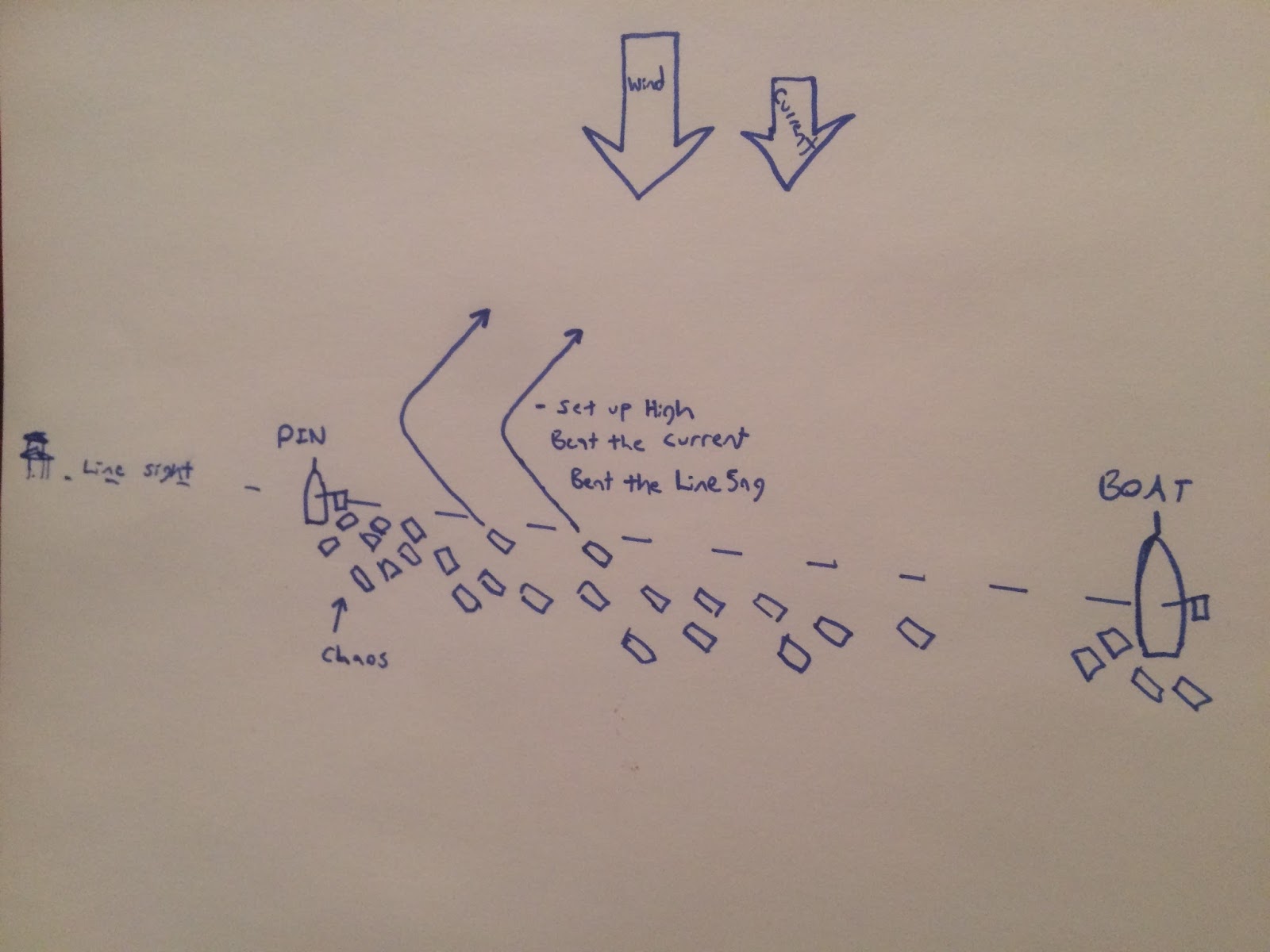
The next race was the most sketchy of the regatta. We had passed low tide, and the current was starting to Flood back into the Bay from the South. The Northerly wind was lightening. So the current was pushing hard over the line - Classic Valentines Regatta conditions! Really! Here is a picture I drew about the 2016 Valentines Regatta that approximates the situation:


As the pin was Favored (further upwind than the Committee Boat end of the line), I recommended to my sailors the Port-Tack Approach. I think it is ideal for Plus current and pin favored Starts, I do it a lot in my own racing, and it was a favorite strategy of Ian Barrows when he placed 2nd at Opti Worlds. 


If you look at how the fleet stacks up at ~1 Minute and understand well how much current there is, you can see if it is going to be a genereal recall. Getting a BFD on a General Recall stinks! You risked everything to gain nothing. Better to approach from below the line and sneak through late only if the Start is actually going to happen. On Race 2A two thirds (TWO THIRDS!) of the Fleet got BFD - Kicked out of the race!!!! - over the course of 4-5 General Recalls. Deana, Avery, Annie (who normally sail on Lake Michigan) and Drew got BFD's on Recalls and watched the race from my coachboat. Tyler and others learned the port tack approach and survived. Racing in a much smaller fleet that was finally able to start Tyler finished 2nd! 

The last beat of this race was super light, but Lulu made a big mistake in how she attempted to cover and dropped from 1st to 4th! Here are some general rules for last leg covering:

*Try to stay between your closest opponents and the finish.

*Try to "herd" them together. When you cover a boats air, they tack; when you loose cover they often keep going. By understanding this the leader can actually control where the boats they are covering are going to sail. I think "Herding" is a good word. 

*Cover between opponents and the pressure (next puff you see on the water. )

*Cover bow out on the long tack, accounting for current. 

*Cover between opponents and the next shift and continue to sail the best strategy. In College sailing one of my self mantras was "never stop thinking strategically." You should not abandon what got you the lead in the first place! 


The finish boat was set to the right of the previous course axis, there was a smokestack on the Tampa shore showing an easterly breeze direction (right shift coming), and there was more pressure visible on the right. The current was now pushing from directly behind you on starboard tack and at your beam on Port. All these factors said "protect the right side!" yet Lulu got in a tacking duel with Jack and then separated left of him and all the other boats. Peter Barnard took what was given to him, sailed to the pressure, and almost won the race (Jack got back from the left just in time to take the gun). Lulu, now over the Port layline thanks to the current lost another boat to finish 4th. It was one of her few mistakes in a great regatta and a good learning opportunity. 


The Race Committee re-set the course to the Easterly wind that had now filled all across the bay, and we started the 3rd race of the day. The current was now running from Committee boat to pin (right to left) but it had lessened somewhat. Again, you have to go off what you observe, not just what the tide table told you! It was hard to tell, but the current was pushing boats down below the line very slightly as well. This and the fact that almost half the fleet had a BFD on their scorecard this early in the regatta meant that there was line sag the 3rd race:


Lulu, Jack and Connor observed the start of 3A, saw the pin was favored, and started atop the pin group (top left of the picture). They finished 1,3,5 and Nico also had a good race. We got to shore around 5pm - the kids had spent 7 hours on the water and were mentally exhausted. 

When the current is pushing you under the line, I favor the opposite approach as when it is running over. Its tough to make the pin, and tough to sail thorough the fleet to the first row on Port. Get a line sight, set up above the fleet, and maintain your position in the first row + for the last 1:30. 


Sunday morning brought light breeze out of the Southe-east. We had talked with the kids about pressure before the regatta - pressure is just your brains way of reminding you that you want to do your best! Lulu and Lucy had resisted the temptation to party too hard the night before (they are definitely the hardest partying Opti sailors) so everyone was alert and ready to go. While 4 of our sailors had a realistic chance to win the regatta and many others were chasing important goals like Team Trials, the kids seemed pretty relaxed and poised. However things shook out on the water would be based on their ability to read the current/conditions, and execute a game plan with good boatspeed, not on anything to do with pressure. 

The chop was steep at first because the current was going out against the wind. The wind picked up to about 12-13 kts - it would be a fun race! Again, we would be reading while it changed, but this time it was the first start of the day where sailors had to be careful. Unfortunately Graceanna and Avery were not and received fatal BFD's - I could see at 1 min. to the start that Graceanna was set up too high, and the RC could certainly see her red sail numbers! Most of the rest of our team set up with a port-tack approach, and had a good first race - Lulu had a beautiful start and won her race, while Kevin, Tyler and James had good races to show that their high standing entering the day was no fluke and Tyler and James would be making Team Trials. Jack and Connor were both a little too conservative - Jack surveying the line from past the pin too late in the sequence and both of them attempting to start on port. The "port-tack approach" does not mean "port tack start!" Connor overcame that and a kinetics penalty on the reach to climb back to 4th while Jack's superior upwind speed got him to 5th. 

The current then shifted, and was pushing sailors below the line, so you could confidently start in the first row. Lulu and Connor both notched bullets, and after some laborious calculation her coaches concluded that she had won the regatta. 

An interesting thing: Why does the left side of the course pay soo much in St. Pete, given that the wind shifts clockwise throughout the day? In this racing area and circumstances, it is due to the underwater geography. Tampa Bay actually gets shallower in the middle! Between the racecourse and the SP Yacht Club there is a dredged shipping channel where a lot of the moving water funnels to. So in this race with the current coming in there was actually a little bit more adverse current sailing upwind if you went too far right. We benefited from this knowledge at the Fall STQ as well as this regatta. The difference in current velocity is not pronounced but it does help to factor in your percentages with which side you choose. 

Connor summed up his strategy really well in this post race interview. He talks about starting ahead and covering his side.  Im impressed he was already thinking ahead to the next race and wanted to be more careful of a predicted right shift. This is why we sometimes pretend he is the assistant coach!


Here's the line sag for race 5:


You can see how the downwind current condenses boats at the pin. Nobody had the understanding of current, line sight, and gumption to start mid line-front row! I wonder what some of the 2nd and 3rd row boats are thinking - they must not be able to see the forest through the trees! 

The sky grew dark and the wind spiked dramatically before the final race. The committee said over the radio that there were storms in the gulf - we told the sailors to keep an eye out for rain that might cause a drastic wind shift - Rain pushes out air creating wind coming from the rain clouds. The rain clouds never came and the wind direction stabilized after shifting right between races 5 and 6, but there was one big difference between this race and all the others: the RC favored the pin by 10 degrees! You can see it in this picture taken just after the start: the Optis on starboard are sailing a ridiculously high angle:


Not enough LYC sailors noticed or took advantage of this skewed start line - that is CRYC's Freddie Parkin punched out as the leftmost sail on the screen - and many had their throw out race to close. The exception was Connor Boland who ground Freddie down on the last beat to take the bullet and move up to 2nd place overall, and Lucy Meagher who was gushing blood from her finger before the race, calmly wrapped it with electrical tape (she knew bandaids would not stick!) and hiked hard to a 6th.  The kids ripped in, packed their boats and got ready for the awards at the end of a tough regatta! 

The Principle Race Officer Todd Fedezyn got all 6 scheduled races off on tricky Tampa Bay and it was good for us to see some of his tendencies as he will be the PRO at Team Trials. I though he did a great job and had a really relaxed demeanor. Here's what we can expect going forward: 

Todd's Tendencies:

*Favor the pin by 10 degrees when the current is pushing over the line - this reduces general recalls/the number of boats OCS. 

*Go to black flag after the 1st general recall.

*Recall subsequent starts where there are too many boats over to identify them all, BFD (remove!) the ones they could identify, then re-start. Repeat until there are few enough BFD's that the RC is  able to identify all of them and let the race go. 

*Be patient with even a really light air race - he did not call of a race that was hovering around 3.5-4 kts . I really agree with this because it takes less time to finish than it does to re-start! 

*Start a race even if the course is not perfect - ex: the boat favored final race that could still be started because of the adverse current keeping boats under the line. 

*Understand and adjust for the current and wind velocity. He shortened the beat when the current was adverse and lengthened when the current was pushing upwind. 

As I said in the opener, the sailors that were on the podium really earned it - this was a challenging regatta! I am proud of the way they competed and the blood (Lucy, Drew) sweat, and tears (multiple parties)  they put into this event. While some clubs just sent the kids that needed to qualify, I think having Lulu, Jack, Connor and Peter to set the example for the up-and-coming team members was really beneficial. Culture feeds culture and we were a team in every sense of the word, from sailors to coaches and parents! 


White Fleet Champ James Asturias 


Friday, January 5, 2018

End of Year Honors for LYC Sailors

Happy New Year from LYC Sailing! 2017 was an incredible year for us, and ended with some nice recognition of some of our sailors:

*Stephan Baker Receives Sail 1 Design/McLaughlin Opti Sailor of the Year Award! You can read about the award here. 

*The LYC Fall Banquet was December 19th.
        - The Mike Toppa perpetual award for Teamwork when to the LYC1 Opti Team Cup Berlin Champs Team of Baker, Connor Bolland, Lulu Hamilton, Sara Schumann and Jack Redmond.
Above: The OTC Team just after the finals. 

      - The Clyde Wright Pram Trophy was awarded to Stephan Baker.
   
      -The Fall Series "Software" (the trophy were fleece blankets) was awarded as follows:
              Green: 1st: Millie French 2nd: Parker Bustamante 3rd Luca Ehring
              Bronze Fleet: 1st: Cole Fanchi, 2nd: Graceanna Dixon 3rd: Skye Johnson
              Silver Fleet: 1st Jake Homberger, 2nd: Cody Roe, 3rd: KJ Hill
              Gold Fleet: 1st Jack Redmond, 2nd Lucy Meagher, 3rd Ryan Kronrad
The Bronze Fleet receive their paper plate awards and pose with JC, Fleet Captain Morley and Coach Arthur. The kid in the middle 2nd row is Coach Pili! 

*Orange Bowl was an awesome 4 day event. Varied winds, currents, challenging courses and a stacked International fleet made for challenging racing! After 2 days of qualifying, 8 of the 17 LYC Sailors made the top 33% Gold fleet. With a stunning comeback on the last race of the regatta Baker took the trophy for the 2nd straight year! Jake Hamburger and Cody Roe also took home some hardware, finishing 2nd and 5th in White Fleet respectively. Schuman, Hamilton and Redmond all had chances to crack the top 10, but Lulu and Jack were black flagged in the last race! LYC's Ty Lamm and Will MacDiarmid were individual race winners in Silver and Bronze fleets respectively.

*End of year national standing:
LYC Sailors on National Team: Stephan Baker, Connor Bolland, Lulu Hamiton, Jack Redmond
LYC Sailors on National Development Team: Sara Schumann, Ryan Konrad, Jake Homberger

These and 6+ other TT qualified sailors now turn our focus to preparing for Team Trials where we hope to continue excellence on a national level! Thank you for being a part of LYC Opti Sailing!
         

Thursday, December 7, 2017

Nasty Boathandeling Shorts Volume 2: Here's a compilation from the practice videos this Fall. Some good technique and tacks and a couple bad tacks! Nice to see our sailors training hard.